The need for simulation

TL;DR: Poor mathematical-based design and testing of models can lead to significant problems in production. Finding suitable ground truth data for testing of models can be difficult. Yet, many Data Science models make it into production without appropriate testing. In these circumstances testing with simulated data can be hugely valuable. In this post I explain why and how. In fact, I argue that testing with Data Science models should be non-negotiable.

Introduction

Imagine a scenario. You’re the manager of a Premier League soccer team. You wouldn’t sign a new striker without testing if they could actually kick a ball. Wouldn’t you?

In the bad old days before VAR it was not uncommon for a big centre-back to openly punch a striker in the face if the referee and assistant referees weren’t looking. Even today, just look at any top-flight soccer match and you’ll see the blatant holding and shirt-pulling that goes on. Real-world soccer matches are dirty. A successful striker has to deal with all these realities of the game, whilst also being able to kick the ball in the net. At the very least when signing a new striker you’d want to test whether they could score under ideal benign conditions. Wouldn’t you? You’d put the ball on the penalty spot, with an open goal, and see if your new striker could score. Wouldn’t you? Passing this test, wouldn’t tell you that your striker will perform well in a real game, but if they fail this “ideal conditions” test it will tell you that they won’t perform well in real circumstances. I call this the “Harry Redknapp test” – some readers will understand the reference1. If you don’t then read the footnote for an explanation.

How is this relevant to Data Science? One of the things I routinely do when implementing an algorithm is to test that implementation on simulated data. However, a common reaction I get from other Data Scientists is, “oh I don’t test on simulated data, it’s not real data. It’s not useful. It doesn’t tell you anything.” Oh yes it does! It tells you whether the algorithm you’ve implemented is accurate under the ideal conditions it was designed for. If your implementation performs badly on simulated data, you have a big problem! Your algorithm or your implementation of it has failed the “Harry Redknapp test”.

“Yeah, but I will have some ground-truth data I can test my implementation on instead, so I don’t need simulated data.” Not always. Are you 100% sure that that ground-truth data is correct? And what if you’re working on an unsupervised problem.

“Ok, but the chances of an algorithm implemented by experienced Data Scientists making it into production untested and with really bad performance characteristics is small”. Really!? I know of at least one implemented algorithm in production at a large organization that is actually an inconsistent estimator. An inconsistent estimator is one of the biggest sins an algorithm can commit. It means that even as we give the algorithm more and more ideal training data, it doesn’t produce the correct answer. It fails the “Harry Redknapp test”. I won’t name the organization in order to protect the guilty. I’ll explain more about inconsistent estimators later on.

So maybe I convinced you that simulated data can be useful. But what can it give you, what can’t it give you, and how do you go about it?”

What simulation will give you and what it won’t

To begin, we need to highlight some general but very important points about using simulated data:

  1. Because we want to want to generate data, we need a model of the data generation process, i.e. we need a generative model2.
  2. Because we want to mimic the stochastic nature of real data, our generative model of the data will be a probabilistic one.
  3. Because we are generating data from a model, what we can test are algorithms and processes that use that data, e.g. a parameter estimation process. We cannot test the model itself. Our conclusions are conditional on the model form being appropriate.

With those general points emphasized, let’s look in detail what we can get testing with simulated data.

What simulated data will give you

We can get a great deal from simulated data. As we said above, what we get is insight into the performance of algorithms that process the data, such as the parameter estimation process. Specifically, we can check whether our parameter estimation algorithm is, under ideal conditions,

  • Consistent
  • Biased
  • Efficient
  • Robust

I’ll explain each of these in detail below. We can also get insight into how fast our parameter estimation process runs or how much storage it requires. Running tests using simulated data can be extremely useful.

Consistency check

As a Data Scientist you’ll be familiar with the idea that if we have only a small amount of training data our parameter estimates for our trained model will not be accurate. However, if we have a lot of training data that matches the assumptions on which our parameter estimation algorithm is based, then we expect the trained parameter estimates to be close to their true values, i.e. close to the values which generated the data. As we increase the amount of training data, we expect our parameters estimates to get more and more accurate, converging ultimately to the true values in the limit of an infinite amount of training data. This is consistency.

In statistics, a formula or algorithm for estimating the parameters of a model is called an estimator. There can be multiple different estimators for the same model, some better than others. A consistent estimator is one whose expected value converges to the true value in the limit of an infinite amount of training data. An inconsistent estimator is one whose expected value doesn’t converge to the true value in the limit of an infinite amount of training data. Think about that for a moment,

An inconsistent estimator is an algorithm that doesn’t get better even when we give it a load more training data.

That is a bad algorithm! That is why I say constructing an inconsistent estimator is one of the worst sins a Data Scientist can commit. Very occasionally (rarely), an inconsistent estimator is constructed because it has other useful properties. But in general, it you encounter an inconsistent estimator you should take it as a sign of incompetence on the part of the Data Scientist who constructed it.

“Okay, okay, I get it. Inconsistent estimators are bad. But I don’t have an infinite amount of training data, so how can I actually check if my algorithm produces a consistent estimator? Surely, it can’t be done?” Yes, it can be done. What we’re looking for is convergence, i.e. parameter estimates getting closer and closer to the true values as we increase the training set size. I’ll give a demonstration of this in the next section when I show how to set up some simulation tests.

Bias check

Along with the concept of consistency comes the concept of bias. We said that a consistent estimator was one whose expectation value converges to the true value in the limit of an infinite amount of training data. However, that doesn’t mean a consistent estimator has an expectation value that is equal to the true value for a finite amount of training data. It is possible to have a consistent estimator that is biased. This means the estimator, on average, will differ from the true value when we use a finite amount of training data. For a consistent estimator, if it is biased that bias will disappear as we continually increase the amount of training data.

As you might have guessed, the best algorithms produce estimators that are consistent and unbiased. Knowing if your estimator is biased and by how much is extremely useful. Again, we can assess bias using simulated data, and I’ll show how to do this in the next section when I show how to set up some simulation tests.

Efficiency check

So far, we have spoken about the expectation or average properties of an algorithm/estimator. But what about its variance. It is all very well telling me that across lots of different instances of training datasets my algorithm would, on average get the right answer, or near the right answer, under ideal conditions, but in the real world I have only one training dataset. Am I going to be lucky and my particular training data will give parameter estimates close to the average behaviour of the algorithm? I’ll never know. But what I can know is how variable the parameter estimates from my algorithm are. I can do this by calculating the variance of the parameter estimates over lots of training datasets. A small variance will tell me that my one real-world dataset is likely to have performance close to the mean behaviour of the algorithm. I may still be unlucky with my particular training data and the parameter estimates are a long way from the average estimates, but it is unlikely. However, a large variance tells me that parameter estimates obtained from a single training dataset will often be a long way from the average estimates.

How can I calculate this variance of parameter estimates over training datasets? Simple, get lots of different training datasets produced under identical controlled conditions. How could I do that? Yep, you guessed it. Simulation. With a simulation process coded up, we can easily generate multiple instances of training datasets of the same size and generated under identical conditions. Again, I’ll demonstrate this in the next section.

Sensitivity check – robustness to contamination

Our message about simulated data is that it allows you to test your algorithm under conditions that match the assumptions made by the algorithm, i.e. under ideal conditions. But you can use simulation to test how well your algorithm performs in non-ideal conditions. We can also introduce contamination into the simulated data, for example drawing some response variable values from a non-Gaussian distribution if our algorithm has assumed the response variable is purely Gaussian distributed. We can produce multiple simulated datsets with different percentages of contamination and so test how sensitive or robust our estimation algorithm is to the level of contamination, i.e. how sensitive it is to non-ideal data.

In the first few pages of the first chapter of his classic textbook on Robust Statistics, Peter Huber describes analysis of an experiment originally due to John Tukey. The analysis reveals that even having just 2% of “bad” datapoints being drawn from a different Gaussian distribution (with a 3-fold larger standard deviation) is enough to markedly change the properties and efficiency of common statistical estimators. And yet, defining “bad” data as being drawn from a larger variance Gaussian is wonderfully simplistic. Real-world data is so much nastier.

What form should the data contamination take? There are multiple ways in which data can become contaminated. There can be changes in statistical properties, like the simple example we used above, or drift in statistical properties such as a non-stationary mean or a non-stationary variance. But you can get more complicated errors creeping into your data. These typically take two forms,

  • Human induced data contamination: These can be misspelling or mis-(en)coding errors that result from not using controlled and validated vocabularies for human data-entry tasks. You’ll recognize these sorts of errors when you see multiple different variants for the name of the same country, US county or UK city, say. You might think it is difficult to simulate such errors, but there are some excellent packages to do so – checkout the messy R package produced by Dr. Nicola Rennie that allows you to take a clean dataset and introduce these sorts of encoding errors into it. Spotting these errors can be as simple as plotting distributions of unique values in a table column, i.e. looking for unusual distributions. In R there are a number of packages to help you do this.
  • Machine induced errors: These are errors that arise from the processing or transferring of data. These can be as simple as incorrect datetime stamps on rows in a database table, or can be as complex as repeating blocks of rows in a table. These errors are less about contamination and more about alteration. The common element here is that there is a pattern to how the data has become altered or modified and so spotting the errors involves visual inspection of the individual rows of the table, combined with plotting lagged or offset data values. The machine induced errors arise because of bugs in processing code, and these can be either coding errors, e.g. a typo in the code, or unintended behaviour, e.g. datetime processing code that hasn’t been designed properly to correctly handle daylight saving switchovers.

What kind of data contamination should I simulate? This is a “how long is a piece of string” kind of question. It very much depends on what aspect of your algorithm or implementation you want to test for robustness, and only you can know that. You may have to write some bespoke code to simulate the sorts of errors that arise in the processes you use or are exposed to. Broadly speaking, robustness of an estimator will be tested by changes in the statistical properties of the input data and these can be simulated by changes in the distributions of data due to data drift or human-induced contamination, whilst machine-induced errors imply you have some sort of deployed pipeline and so simulating machine corrupted data is best when you want to stress-test your end-to-end pipeline.

Runtime scaling

There are also checks that simulated data allows you to perform that aren’t necessarily directly connected to the accuracy or efficiency of the parameter estimates. Because we can produce as much simulated data as we want, we can easily test how long our estimation algorithm takes for different sized datasets. Similarly, we can also use simulated data to test the memory and storage requirements of the algorithm.

We can continue this theme. Because we can tune and tweak the generation of the simulated data, this can also allow us to generate data to test very specific scenarios – corner cases – for which we don’t have real test data. The ability to generate simulated data increases the test coverage we can perform.

What simulated data won’t give you

Identify model mis-specification

Using simulated data will tell you how well your model training algorithm performs on data that matches precisely the form of the model you have used. It won’t tell you if your model form is correct or appropriate for the real data you will ultimately apply it to. It won’t tell you if you’ve omitted an important feature or if you’ve put non-linearity into your model in an incorrect way. Getting the model form right can only come from i) domain expertise, ii) testing on real ground-truth data. Again, what this highlights is that we use simulated data to test the training process, not the model.

This can trip up even experience researchers. I recently saw a talk from an academic researcher who tested two different model forms using simulated data generated from one of the models. When the model form used to generate the data fitted the simulation data better, they confidently claimed that this model was better and more correct. Well, of course it was for this simulated data!

Accuracy of your model on real data

For simulated data we have the ground-truth values of the response variable so we can assess the prediction accuarcy, either on training data or on holdout test data. However, unless our simulation process produced very realistic data, including the various contamination processes, the test set accuracy on simulated data cannot be used as a precise measure of the predictive accuracy of the trained model on real unseen data.

How to simulate

When producing simulated data for testing an algorithm related to a model there are two things we need to generate – the features and the response. There are two ways we can approach this,

  1. Simulating the features and then simulating the response given the feature values we just produced.
  2. Simulate just the response value given some pre-existing feature values.

Of these, 2 sounds easier, but I will discuss 1 first as it leads us naturally into discussing where we might get pre-existing feature values from.

Simulating features and response

As we said above, in this approach we simulate the features first, and this allows us to construct the distribution of the response variable conditional on the features. We can then sample a value from that conditional distribution. Our basic recipe is

  1. Sample the feature values from a distribution.
  2. Use the sampled feature values and the model form to construct the distribution of the response variable conditional on the features.
  3. Sample the response variable from the conditional distribution constructed in 2.

How complex we want to make the feature distribution depends on how realistic we need our features to be and what aspect of the estimation/training algorithm we are wanting to test.

For real-world problems, it is unlikely that the features follow a Gaussian distribution. Take demand modelling, an area I have worked in a lot. The main feature we use is the price of the product whose demand we are trying to predict. Prices are definitely not Gaussian distributed. Retailers repeatedly switch between a regular and promotional price over a long period of time, so that we have a sample distribution of prices that is represented by two Dirac-delta functions. A more interesting price time series may introduce a few more price points, but it is still definitely not Gaussian. Similarly, real data has correlations between features.

When simulating a feature, we have to decide how important the real distribution is to the aspect of the estimation/training algorithm that we want to test. If we want to simulate with realistically distributed features. this can be problematic. We’ll return to this issue and real data later on, but for now we emphasize tha we can still test whether our estimator is consistent or assess its bias using features drawn from independent Gaussian distributions. So there are still useful tests of our estimation algorithm we can carry out. Let’s see how we can do that.

Linear model example

We’ll use a simple linear model that depends on three features, x_{1}, x_{2}, x_{3}. The response variable y is given by,

y\; =\;\beta_{1} x_{1}\;+\; \beta_{2}x_{2}\;+\;\beta_{3}x_{3} \;+\;\epsilon\;\;\;\;,\;\; \epsilon\;\sim\; {\cal{N}}\left ( 0, \sigma^{2}_{\epsilon}\right )

From which you can see both the linear dependence on the features and that y contains Gaussian additive noise \epsilon.

Simulating data is now easy once we have the structure of our probabilistic model. Given a user-specified mean \mu_{1} and variance \sigma^{2}_{1} we can easily sample a value for x_{1} from {\cal{N}}\left ( \mu_{1}, \sigma^{2}_{1}\right ). Similarly, given user-specified means \mu_{2}, \mu_{3} and variances \sigma^{2}_{2}, \sigma^{2}_{3}, we can generate values for x_{2} and x_{3}.  If we have user-specified values of \beta_{1}, \beta_{2}, \beta_{3} we can then easily generate a value for y by sampling from {\cal{N}}\left ( \beta_{1}x_{1} + \beta_{2}x_{2} + \beta_{3}x_{3}, \sigma^{2}_{\epsilon} \right ), where \sigma^{2}_{\epsilon} is the variance of the additive noise that we want to add to our response variable. To simulate N datapoints we repeat that recipe N times. Let’s apply that recipe to assess an estimator of the model parameters \beta_{1}, \beta_{2}, \beta_{3}. We’ll assess the standard Ordinary Least Squares (OLS) estimator for a linear model.

Assessing the OLS Estimator for a linear model

Given a feature matrix \underline{\underline{X}} (the ith row of the matrix is the feature values for the ith observation) and vector \underline y = \left ( y_{1}, y_{2},\ldots,y_{N}\right ) that represents the N observations of the response variable, then the Ordinary Least Squares (OLS) estimator \hat{\beta} of the true model parameters \underline{\beta} = \left ( \beta_{1}, \beta_{2}, \beta_{3}\right ) is given by the formula,

\underline{\hat{\beta}}\;=\; \left ( \underline{\underline{X}}^{\top}\, \underline{\underline{X}}\right ) ^{-1} \underline{\underline{X}}^{\top} \underline{y}\;\;\;\;\;\;\;{\rm Eq.1}

Note that the OLS estimator is a linear combination of the observations y_{1}, y_{2}, \ldots, y_{N}, with a weight matrix \left ( \underline{\underline{X}}^{\top}\, \underline{\underline{X}}\right )^{-1} \underline{\underline{X}}^{\top}. We’ll come back to this point in a moment.

What we want to know is how close is the estimate \underline{\hat{\beta}} to \underline{\beta}. Is the OLS estimator in the Eq.1 above a biased estimator of \underline{\beta}, and is it a consistent estimator?

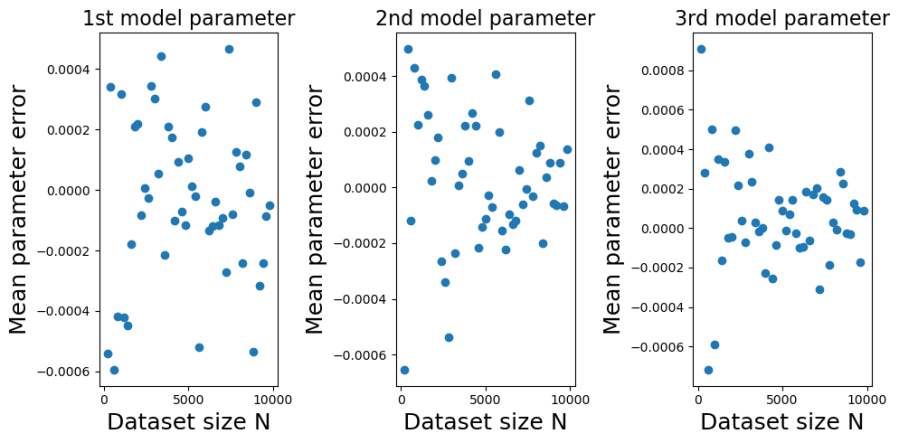
The plots below show the bias (mean error)  for each of the model parameters, plotted against training dataset size N. I constructed the plots by initializing a true model parameter vector \underline{\beta} and then generating 1000 simulated training datasets for each of the different values of N. For each simulated training dataset I computed the OLS parameter estimate \hat{\underline{\beta}} and then computed the parameter estimate errors \hat{\underline{\beta}} - \underline{\beta}. From the errors I then calculated their sample means and variances (over the simulations) for each value of N.

You can see from the plots that whilst the mean error fluctuates it doesn’t systematically change with N. Furthermore, it fluctuates around zero, suggesting that the OLS estimator is unbiased. And indeed it is. It is possible to mathematically show that the OLS estimator is unbiased at any finite value of N. The reason we get a non-zero value in this case is because we have estimated \mathbb{E}\left ( \hat{\beta}_{i}\right ) using a sample average taken over 1000 simulated datasets. If we had used a larger number of simulated datasets we would have got even smaller sample average parameter errors.

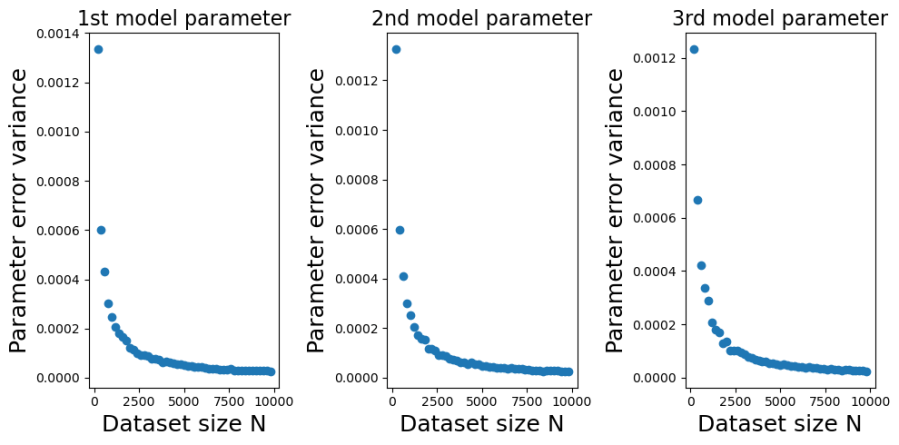
Contrast this behaviour with how the variances of the parameter estimate errors change with N in the plots below.

The decrease, with N, in the variance of \hat{\underline{\beta}} - \underline{\beta} is marked. In fact, in looks like a power-law decrease, so I have plotted the same data on a log-scale below,

We can see from those log-log plots that the variances of \hat{\beta}_{i} - \beta_{i},\; i=1,2,3 decrease as N^{-1}. That implies that as we use larger and larger training sets any single instance of \hat{\underline{\beta}} will get closer and closer to \underline{\beta}. At large N we have a low probability of being unlucky and our particular training set giving a poor estimate of \underline{\beta}.

How efficient is the OLS estimator in Eq.1? Is the rate at which {\rm Var}\left ( \hat{\beta}_{i} - \beta_{i}\right ) decreases with N good or bad? It turns out that the OLS estimator in Eq.1 is the Best Linear Unbiased Estimator (BLUE). For an unbiased estimator of \underline{\beta} that is constructed as a linear combination of the observations \underline{y}, you cannot do better than the OLS estimator in Eq. 1.

All the code for the linear model example is available in the Jupyter notebook NeedForSimulation_Blogpost.ipynb in the GitHub repository https://github.com/dchoyle/simulation_blogpost.

A linear model is relatively simple structure but the example was a good demonstration of the power of simulated data. Next, we’ll use a more complex model architecture and build a feed-forward neural network.

Neural network example

Our simulated neural network output has the form,

y\;=\; f\left( \underline{x}| \underline{\theta} \right ) \;+\; \epsilon

Again, we’ll use zero-mean Gaussian additive noise, \epsilon \sim {\cal{N}}\left (0, \sigma^{2}_{\epsilon}\right ).

The function f\left( \underline{x}| \underline{\theta} \right ) represents our neural network function, with \underline{x} being the vector of input features and \underline{\theta} being a vector holding all the network parameters. For this demo, I’m going to use a 3 input-node, 2 hidden-layer feed-forward network, with 10 nodes in each of the hidden layers. The output layer consists of a single node, representing the variable y. For the non-linear transfer (activation) functions I’m going to use \tanh functions. So, schematically, my networks looks like the figure below,

I’m going to use a teacher network of the form above to generate simulated data, which I’ll then use to train a student network of the same form. What I want to test is, does my training process produce a trained student network whose predictions on a test set get more and more accurate as I increase the amount of training data? If not, I have a problem. If my training process doesn’t produce accurate trained networks on ideal data, the training process isn’t going to produce accurate networks when using real data. I’m less interested in comparing trained student network parameters to the teacher network parameters as, a) there are a lot of them to compare, b) since the output of a network is invariant to within-layer permutation of the hidden layer node labels and connections, defining a one-to-one comparison of network parameters is not straight forward here. Node 1 in the first hidden layer of the student isn’t necessarily equivalent to node 1 in the first hidden layer of the teacher network, and so on.

The details of how I’ve coded up the networks and set-up the evaluation are lengthy, so I’ll just show the final result here. All the details can be found in the Jupyter notebook NeedForSimulation_Blogpost.ipynb in the freely accesible github repository.

Below in left-hand plot I’ve plotted the average Mean Square Error (MSE) made by the trained student network on the test-sets. I’ve plotted the average MSE against the training dataset size. The average MSE is the average over the simulations of that training set size. For comparison, I have also calculated the average test-set MSE of the teacher network. Since the test-set data contains additive Gaussian noise, the teacher network won’t make perfect predictions on the test-set data even though the teacher network generated the systematic part of the test-set response values. The average test-set MSE of the teacher network provides a benchmark or baseline against which we can asses the trained student network. We have a ready intuition about the relative test-set MSE value. We expect the relative test-set MSE to be significantly above 1 at small values of N, as the student network struggles to learn the teacher network output. As the amount of training data N increases we expect the relative test-set MSE value to approach 1 from above. The average relative test-set error is plotted in the right-hand plot below.

We can see from both plots above that the prediction accuracy of a trained student network typically decreases with increasing amount of training data. My network training process has passed this basic test. The test was quick to set up and gives me confidence I can run my code over real data.

Sampling features from more realistic distributions

In our previous examples we have used independent features, sampled from simple but naive distributions, to test the convergence properties of an estimator. But what happens if you want to assess the quantitative performance of an estimator for more realistic feature patterns? Well, we use more realistic feature patterns. This is a variant of our previous basic recipe, but where we have access to a real dataset. The modified recipe is,

  1. Sample an observation from the real dataset and keep the features.
  2. Use the sampled feature values and the model form to construct the distribution of the response variable conditional on the features.
  3. Sample the response variable from the conditional distribution constructed in 2.

This seems like a small modification of the recipe. However, it does have some big implications. We can’t generate simulated datasets of arbitrarily large size as we are limited by the size of the real dataset. We can obviously generate simulated datasets of smaller size than the real data, but this can make testing of the convergence properties of an estimator difficult.

That said, this is one of my faviourite approaches. Often, steps 2 and 3 are easy to implement. You’ll have a function for the conditional mean of the response variable  already coded up for prediction purpose, so it is just a question of pushing some feature values through that code. I find the overhead of writing extra functions to simulate realistic looking feature values is significant, both in terms of time and thinking about what ‘realistic’ should look like. The recipe above gets round this easily. Simply pick a row from your existing real dataset at random and there you go, you have some realistic feature values. As before, the recipe allows me to then generate response values with known ground-truth parameters values. So overall I can compare parameter estimates to ground truth parameter values on realistic feature values, allowing me to check that my estimation algorithm is at least semi-accurate on realistic feature values. You can also choose in step 1 of the recipe, whether you want to sample a row of feature values with or without replacement.

Simulating the response only

You could argue that simulating response values with feature values sampled from an existing real dataset is an example of just simulating the response. After all, only the response value is computer generated. I still tend to think of it as simulating the features because, i) I am still sampling the features from a distribution function, the empirical distribution function in this case, and ii) I have broken some of the link between the features and the response in the real data because I have sampled the features values separately. However, sometimes we want to keep as much as of the links between features and response values in the real data as possible. We can do this by only making additions to the real data. By necessity this means only adding to the response value. This may sound very restrictive, but in fact there are many situations where this is precisely the kind of data we need to test an estimation algorithm. For example, changepoint detection or unconditional A/B testing. In these situations we take the real data, identify the split point where we want to increase the response value (the changepoint or the A/B grouping) and simply increase the response. Hey presto, we have realistic data with a guaranteed increase in the response variable at a know location. By changing the level of increase in the response variable we can use this approach to assess the statistical power of the changepoint or A/B test algorithm.

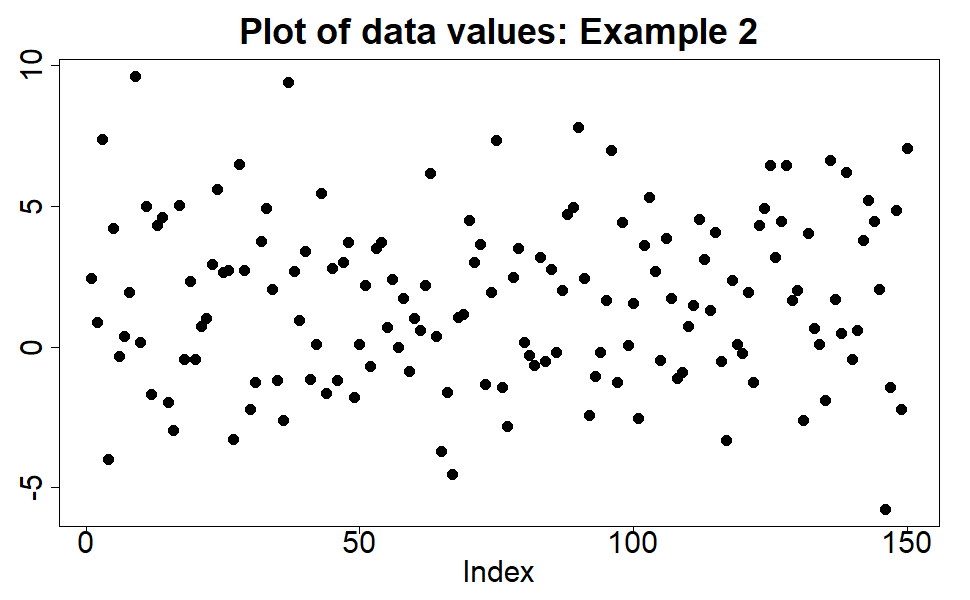
The plots below show an example of introducing a simple shift in level at timepoint 53 into a real dataset. We have only shown the process as a simple schematic, but coding it up yourself is only a matter of a line or two of code, so I haven’t given any code details.

In the above example I simply increased the response variable, by the same amount (8.285 in this case), at and after timepoint 53. If instead, you only want to increase the average value of the response variable, it is a simple modification of the process to include some additional zero-mean noise after the changepoint location.

Conclusions

Simulated data is extremely useful. It can give you lots of insight into the performance of your training/estimation algorithm (including bug detection). Its main advantages are it is,

  • Easy to produce in large volumes.
  • Can be produced in a user-controlled way.
  • Gives you ground-truth values.
  • Gives you a way to assess the performance of your training algorithm when you have no real ground-truth data.
  • Stops you releasing a poor untested training algorithm into production.

If you don’t want to sign an absolutely useless striker for your data science model team, test with simulated data at the very minimum.

Footnotes
  1. Harry Redknapp is a former English Premier League football manager. Whilst Redknapp was manager of Tottenham Hotspur he had a reputation of being willing to sign players on the flimiest of evidence of footballing skills. At a time when there was a large influx of overseas players into the Premier league, due to their reputation for superior technical football skills, it was joked that he would sign a player simply because of how their name sounded and without any checks on the player at all.
  2. The term generative model preceeds its useage in Generative AI. Broadly speaking, a generative model is a machine learning model that learns the underlying probability distribution of the data and can generate new, similar data instances. The useage of the term was popular around the early 2000’s, particularly when discussing different forms of classifiers, which were described as either being generative or discriminative.

© 2025 David Hoyle. All Rights Reserved

A book on language models and a paper on the mathematics of transformers

Quick introductions to the maths of transformers

TL;DR: Having a high-level understanding of the mathematics of transformers is important for any Data Scientist. The two sources I recommend below are excellent short introductions to the maths of transformers and modern language models.

A colleague asked me, about two months back, if I could recommend any articles on the mathematics of Large Language Models (LLMs). They then clarified that they meant transformers, as they were primarily interested in the algorithms on which LLM apps are based. Yes, they’d skim read the original “Attention Is All You Need” paper from Vaswani et al, but they done so just after the paper came out in 2017. They were looking to get back up to date with LLMs and even revisit the original Vaswani paper. Firstly, they wanted an accessible explanation which they could use to construct a high-level mental model of how transformers worked, the idea being that the high-level mental model would serve as a construct on which to hang and compartmentalize the many new concepts and advances that had happened since the Vaswani paper. Secondly, my colleague is very mathematically able, so they were looking for mathematical detail, but the right mathematical detail, and in a relatively short read.

I’ve listed below the recommendations I gave to my colleague because I think they are good recommendations (and I explain why below as well). I also believe it is important for all Data Scientists to have at least a high-level understanding of how transformers, and the LLMs which are built on them, work – again I explain why, below.

The recommendations

What I recommended was one paper and one book. The article is free to access, and the book has a “set your own price” option for access to the electronic version of the book.

  • The article is, “An Introduction to Transformers” by Richard Turner from the Dept. of Engineering at the University of Cambridge and Microsoft Research in Cambridge (UK). This arXiv paper can be found here.  The paper focuses on how transformers work but not on training them. That way the reader focuses on the structure of the transformers without getting lost in the details of the arcane and dark art of training transformers. This is why I like this paper. It gives you an overview of what transformers are and how they work without getting into the necessary but separate nitty-gritty of how you get them to work. To read the paper does require some prior knowledge of mathematics but the level is not that high – see the last line of the abstract of the paper. The whole paper is only six pages long, making it a very succinct explanation of transformer maths that you can consume in one sitting.
  • The book is “The Hundred-Page Language Models Book” by Andriy Burkov. This is the latest in the series of books from Burkov, that include “The Hundred-Page Machine Learning Book” and “Machine Learning Engineering”. I have a copy of the hundred-page machine learning book and I think it is ok, but I prefer the LLMs book. I think part of the reason for this is that, like everybody else I have been only been using and playing with LLMs for the last three years or so, whilst I have been doing Data Science for a lot longer – I have been doing some form of mathematical or statistical modelling for over 30years – and so I didn’t really learn anything new from the machine learning book. In contrast, I learnt a lot from the book on LLMs. The whole book works through simple examples, both in code (Python) and in terms of the maths. I semi-skim read the book in two sittings. The code examples I skipped, not because they were simplistic but because I wanted to digest the theory and algorithm explanations end-to-end first and then return to trying the code examples at a later date. Overall, the book is packed with useful nuggets. It is a longer read than the Turner paper, but can still easily be consumed in a day if you skip bits. The book assumes less prior mathematical knowledge than the Turner paper and explains the new bits of maths it introduces, but given the whirlwind nature of a 100-page introduction to LLMs I would still recommend you have some basic familiarity with linear algebra, statistics & probability, and machine learning concepts.

Why learn the mathematics of transformers?

Having to think about which short articles I would recommend on the maths of transformers and LLMs made me think more broadly about whether there is any benefit from having a high-level understanding of transformer maths. My colleague was approaching it out of curiosity, and I knew that. They simply wanted to learn, not because they had to, nor because they thought that understanding the mathematical basis of transformers was the way to approach using LLMs as a tool.

However, given the exorbitant financial cost of building foundation models and the need to master a vast amount of engineering detail, most people won’t be building their own foundation models. Instead they will be using 3rd party models simply as a tool and focusing on developing skills and familiarity in prompting them. So, are there any benefits then to understanding the maths behind LLMs? In other words, could I honestly recommend the two sources listed above to anybody else other than my colleague who was interested mainly out of curiousity?

The benefits of learning the maths of transformers and the risks of not doing so

The answer to the question above, in my opinion, is yes. But you probably could have guessed that from the fact I’ve written this post. So, what do I think are the benefits to a Data Scientist in having a high-level understanding of the mathematics of transformers? And equally important, what are the downsides and risks of not having that high-level understanding?

  1. Having even a high-level understanding of the maths behind transformers de-mystifies LLMs since it forces you to focus on what is inside LLMs. Without this understanding you risk putting an unnecessary veneer of complexity or mysticism on top of LLMs, a veneer that prevents you using LLMs effectively.
  2. You will understand why LLMs hallucinate. You will understand that LLMs build a model of the high-dimensional conditional probability distribution of the next token given the preceding context. And that distribution can have a large dispersion if the the training data is limited in the high-dimensional region that corresponds to the current context. That large dispersion results in the sampled next token having a high probability of being inappropriate. If you understand what LLMs are modelling and how they model it, hallucinations will not be a surprise to you (they may still be annoying) and you will understand strategies to mitigate them. If you don’t understand how LLMs are modelling the conditional probability of the next token, you will always be surprised, annoyed, and impacted by LLM hallucinations.
  3. It helps you understand where LLMs excel and where they don’t because you have a grounded understanding of their strengths and weaknesses. This makes it easier to identify potential applications of LLMs. The downside? Not having a fundamental understanding of the strengths and weaknesses of the algorithms behind LLMs risks you building LLM-based applications that were doomed to failure from the start because they have been mis-matched to the capabilities of LLMs.
  4. By having a high-level mental model of transformers on which to hang later advances in LLMs, you can more easily identify what is important and relevant (or not) in any new advance. The downside to not having this well-founded mental-model is that you get blown about by the winds of over-hyped LLM announcements from companies stating that their new tool or app is a “paradigm shift”, and consequently you waste time getting into the detail of what are trivial or inconsequential improvements.

What to do?

What should you do if you are a Data Scientist and I have managed to convince you that having a high-level understanding of the mathematics of transformers is important? Simple, access the two sources I’ve recommended above. Happy reading.

© 2025 David Hoyle. All Rights Reserved

Comparison of Benford's Law and the proportion of first digits from file sizes of files on my laptop hard drive.

A Christmas Cracker Puzzle – Part 2

Before Christmas I set a little puzzle. The challenge was to calculate the proportion of file sizes on your hard drive that start with the digit 1. I predicted that the proportion you got was around 30%. I’ll now explain why.

Benford’s Law

The reason why around 30% of all the file sizes on your hard disk start with 1 is because of Benford’s Law. Computer file sizes approximately follow Benford’s Law.

What is Benford’s Law?

Benford’s Law says that for many datasets the first digits of the numbers in the dataset follow a particular distribution. Under Benford’s Law, the probability of the first digit being equal to d is,

\log_{10} ( 1 + \frac{1}{d} )\;\;\;.\;\;\;\;\;\; Eq.1

So, in a dataset that follows Benford’s Law, the probability that a number starts with a 1 is around 30%. Hence, the percentage of file sizes that start with 1 is around 30%.

The figure below shows a comparison of the distribution in Eq.1 and the distribution of first digits of file sizes for files in the “Documents” folder of my hard drive. The code I used to calculate the empirical distribution in the figure is given at the end of this post. You can see the distribution derived from my files is in very close agreement with the distribution predicted by Eq.1. The agreement between the two distributions in the figure is close but not perfect – more on that later.

Benford’s Law is named after Frank Benford, whose discovered the law in 1938 – see the later section for some of the long history of Benford’s Law. Because Benford’s Law is concerned with the distribution of first digits in a dataset, it is also commonly referred to as, ‘the first digit law’ and also the ‘significant digit law’.

Benford’s Law is more than just a mathematical curiosity or Christmas cracker puzzle. It has some genuine applications – see later. It has also fascinated mathematicians and statisticians because it applies to so many diverse datasets. Benford’s Law has been shown to apply to datasets as different as the size of rivers and election results.

What’s behind Benford’s Law

The intuition behind Benford’s Law is that if we think there are no a priori constraints on what value a number can take then we can make the following statements,

  1. We expect the numbers to be uniformly distributed in some sense – more on that in a moment.
  2. There is no a priori scale associated with the distribution of numbers. So, I should be able to re-scale all my numbers and have a distribution with the same properties.

Overall, this means we expect the numbers to be uniformly distributed on a log scale.

This intuition helps us identify when we should expect a dataset to follow Benford’s Law, and it also gives us a hand-waving way of deriving the form of Benford’s Law in Eq.1.

Deriving Benford’s Law

First, we restrict our numbers to be positive and derive Benford’s Law. The fact that Benford’s Law would also apply to negative numbers once we ignore their sign should be clear.

We’ll also have to restrict our positive numbers to lying in some range [\frac{1}{x_{max}}, x_{max}] so that the probability distribution of x is properly normalized. We’ll then take the limit x_{max}\rightarrow\infty at the end. For convenience, well take x_{max} to be of the form x_{max} = 10^{k_{max}}, and so the limit x_{max}\rightarrow\infty corresponds to the limit k_{max}\rightarrow\infty.

Now, if our number x lies in [\frac{1}{x_{max}}, x_{max}] and is uniformly distributed on a log-scale, then the probability density for x is,

p(x) = \frac{1}{2\ln x_{max}} \frac{1}{x}\;\;.

The probability of getting a number between, say 1 and 2 is then,

{\rm{Prob}} \left ( 1 \le x < 2 \right ) = \frac{1}{2\ln x_{max}} \int_{1}^{2} \frac{1}{x} dx \;\;.

Now numbers which start with a digit d are of the form a10^{k} with a \in [d, d+1) and k = -k_{max},\ldots,-2,-1,0,1,2,\ldots,k_{max}. So, the total probability of getting such a number is,

{\rm{Prob}} \left ( {\rm{first\;digit}}\;=\;d \right ) = \sum_{k=-k_{max}}^{k_{max}}\frac{1}{2\ln x_{max}}\int_{d10^{k}}^{(d+1)10^{k}} \frac{1}{x} dx\;\; ,

and so after performing the integration and summation we have,

{\rm{Prob}} \left ( {\rm{first\;digit}}\;=\;d \right ) = \frac{2k_{max}}{2\ln x_{max}} \left [ \ln ( d+1 ) - \ln d\right ]\;\;.

Recalling that we have chosen x_{max} =10^{k_{max}}, we get,

{\rm{Prob}} \left ( {\rm{first\;digit}}\;=\;d \right ) = \frac{1}{\ln 10} \left [ \ln ( d+1 ) - \ln d\right ]\;=\;\log_{10} \left ( 1 + \frac{1}{d}\right )\;\;.

Finally, taking the limit k_{max}\rightarrow\infty gives us Benford’s Law for positive valued numbers which are uniformly distributed on a log scale.

Ted Hill’s proof of Benford’s Law

The derivation above is a very loose (lacking formal rigour) derivation of Benford’s Law. Many mathematicians have attempted to construct a broadly applicable and rigorous proof of Benford’s Law, but it was not until 1995 that a widely accepted proof was derived by Ted Hill from Georgia Institute of Technology. You can find Hill’s proof here. Ted Hill’s proof also seemed to reinvigorate interest in Benford’s Law. In the following years there were various popular science articules on Benford’s Law, such as this one from 1999 by Robert Matthews in The New Scientist. This article was where I first learned about Benford’s Law.

Benford’s Law is base invariant

The approximate justification we gave above for why Benford’s Law works made no explicit reference to the fact that we were working with numbers expressed in base 10. Consequently, that justification would be equally valid if we were working with numbers expressed in base b. This means that Benford’s Law is base invariant, and a similar derivation can be made for base b.

The distribution of first digits given in Eq.1 is for numbers expressed in base 10. If we express those same numbers in base b and write a number x in base b  as,

x = x_{1}x_{2}x_{3}\ldots x_{K}\;\;,

then the first digit x_{1} is in the set \{1,2,3,\ldots,b-1\} and the probability that the first digit has value d is given by,

{\rm{Prob}} \left ( x_{1}\;=\;d \right ) = \log_{b}\left ( 1 + \frac{1}{d}\right )\;\;\;,\; d\in\{1,2,3,\ldots,b-1\}\;\;\;.\;\;\;\;\; Eq.2

When should a dataset follow Benford’s Law?

The broad intuition behind Benford’s Law that we outlined above also gives us an intuition about when we should expect Benford’s Law to apply. If we believe the process generating our data is not restricted in the scale of the values that can be produced and there are no particular values that are preferred, then a large dataset drawn from that process will be well approximated by Benford’s Law. These considerations apply to many different types of data generating processes, and so with hindsight it should not come as a surprise to us that many different datasets appear to follow Benford’s Law closely.

This requires that no scale emerges naturally from the data generating process. This means the data values shouldn’t be clustered around a particular value, or particular values. So, data drawn from a Gaussian distribution would not conform to Benford’s law. From the perspective of the underlying processes that produce the data, this means there shouldn’t be any equilibrium process at work, as that would drive the measured data values to the value corresponding to the equilibrium state of the system. Likewise, there should be no constraints on the system generating the data, as the constraints will drive the data towards a specific range of values.

However, no real system is truly scale-free. The finite system size always imposes a scale. However, if we have data that can vary over many orders of magnitude then from a practical point of view, we can regard that data as effectively scale free. I have found that data that varies over 5 orders of magnitude is usually well approximated by Benford’s law.

Because a real-world system cannot really ever truly satisfy the conditions for Benford’s Law, we should expect that most real-world datasets will only show an approximate agreement with Benford’s Law. The agreement can be very close, but we should still expect to see deviations from Benford’s Law – just as we saw in the figure at the top of this post. Since real-world datasets won’t follow Benford’s Law precisely, we also shouldn’t expect to see a real-world dataset follow the base-invariant form of Benford’s Law in Eq.2 for every choice of base. In practice, this means that there is usually a particular base b for which we will see closer agreement with the distribution in Eq.2, compared to other choices of base.

Why computer file sizes follow Benford’s Law

Why does Benford’s Law apply to the sizes of the files on your computer? Those file sizes can span over several orders of magnitude – from a few hundred bytes to several hundred megabytes. There is also no reason why my files should cluster around a particular file size – I have photos, scientific and technical papers, videos, small memos, slides, and so on. It would be very unusual if all those different types of files, from different use cases, end up having very similar sizes. So, I expect Benford’s Law to be a reasonable description of the distribution of first digits of the file sizes of files in my “Documents” folder.

However, if the folder I was looking at just contained, say, daily server logs, from a server that ran very unexciting applications, I would expect the server log file size to be very similar from one day to the next. I would not expect Benford’s Law to be a good fit to those server log file sizes.

In fact a significant deviation from Benford’s Law in the file size distribution would indicate that we have a file size generation process that is very different from a normal human user going about their normal business. That may be entirely innocent, or it could be indicative of some fraudulent activity. In fact, fraud detection is one of the practical applications of Benford’s Law.

The history of Benford’s Law

Simon Newcomb

One of the reasons why the fascination with Benford’s Law endures is the story of how it was discovered. With such an intriguing mathematical pattern, it is perhaps no surprise to learn that Frank Benford was not the first scientist to spot the first-digit pattern. The astronomer Simon Newcomb had also published a paper on, “the frequency of use of the different digits in natural numbers” in 1881. Before the advent of modern computers, scientists and mathematicians computed logarithms by looking them up in mathematical tables – literally books of logarithm values. I still have such a book from when I was in high-school. The story goes that Newcomb noticed that in a book of logarithms the pages were grubbier, i.e. used more, for numbers whose first significant digit was 1. From this Newcomb inferred that numbers whose first significant digit was 1 must be more common, and he supposedly even inferred the approximate frequency of such numbers from the relative grubbiness of the pages in the book of logarithms.

In more recent years the first-digit law is also referred to as the Newcomb-Benford Law, although Benford’s Law is still more commonly used because of Frank Benford’s work in popularizing it.

Benford’s discovery

Frank Benford rediscovered the law in 1938, but also showed that data from many diverse datasets – from the surface area of rivers to population sizes of US counties – appeared to follow the distribution in Eq.1. Benford then published his now famous paper, “The law of anomalous numbers”.

Applications of Benford’s Law

There are several books on Benford’s Law. One of the most recent, and perhaps the most comprehensive is Benford’s Law: Theory and Applications. It is divided into 2 sections on General Theory (a total of 6 chapters) and 4 sections on Applications (a total of 13 chapters). Those applications cover the following:

  • Detection of accounting fraud
  • Detection of voter fraud
  • Measurement of the quality of economic statistics
  • Uses of Benford’s Law in the natural sciences, clinical sciences, and psychology.
  • Uses of Benford’s Law in image analysis.

I like the book because it has extensive chapters on applications written by practitioners and experts on the uses of Benford’s Law, but the application chapters make links back to the theory.

Many of the applications, such as fraud detection, are based on the idea of detecting deviations from the Benford Law distribution in Eq.1. If we have data that we expect to span several orders of magnitude and we have no reasons to suspect the data values should naturally cluster around a particular value, then we might expect it to follow Benford’s Law closely. This could be sales receipts from a business that has clients of very different sizes and sells goods or services that vary over a wide range of values. Any large deviation from Benford’s Law in the sales recipts would then indicate the presence of a process that produces very specific receipt values. That process could be data fabrication, i.e. fraud. Note, this doesn’t prove the data has been fraudulently produced, it just means that the data has been produced by a process we wouldn’t necessarily expect.

My involvement with Benford’s Law

In 2001 I published a paper demonstrating that data from high-throughput gene expression experiments tended to follow Benford’s Law. The reasons why mRNA levels should follow Benford’s Law is ultimately those we have already outlined – mRNA levels can range over many orders of magnitude and there are no a priori molecular biology reasons why, across the whole genome, mRNA levels should be centered around a particular value.

In December 2007 a conference on Benford’s Law was organized by Prof. Steven Miller from Brown University and others. The conference was held in a hotel in Sante Fe and was sponsored/funded by Brown University, the University of New Mexico, Universidade de Vigo, and the IEEE. Because of my 2001 paper, I received an invitation to talk at the workshop.

For me, the workshop was very memorable for many reasons,

  1. I had a very bad cold at the time.
  2. Due to snow in both the UK and US, I was snowbound overnight in Chicago airport (sleeping in the airport), and only just made a connecting flight in Dallas to Albuquerque. Unfortunately, my luggage didn’t make the flight connection and ended up getting lost in all the flight re-arrangements and didn’t show up in Santa Fe until 2 days later.
  3. It was the first time I’d seen snow in the desert – this really surprised me. I don’t know why, it just did.
  4. Because of my cold, I hadn’t finished writing my presentation. So I stayed up late the night before my talk to finish writing my slides. To sustain my energy levels through the night whilst I was finishing writing my slides, I bought a Hershey bar thinking it would be similar to chocolate bars in the UK. I took a big bite from the Hershey bar. Never again.
  5. But this was all made up for by the fact I got to sit next to Ted Hill during the workshop dinner. Ted was one of the most genuine and humble scientists I have had the pleasure of talking to. Secondly, the red wine at the workshop dinner was superb.

From that workshop Steven Miller organized and edited the book on Benford’s Law I referenced above. Hence why I think that book is one of the best on Benford’s Law, although I am biased as I contributed one of the chapters – Chapter 16 on “Benford’s Law in the Natural Sciences”

My Python code solution

To end this post, I have given below the code I used to calculate the distribution of first digits of the file sizes on my laptop hard drive.

import numpy as np

# We'll use the pathlib library to recurse over
# directories
from pathlib import Path

# Specify the top level directory
start_dir = "C:\\Users\\David\\Documents"

# Use a list comprehension to recursively loop over all sub-directories 
# and get the file sizes
filesizes = [path.lstat().st_size for path in list(Path(start_dir).glob('**/*' )) if path.is_file()]

# Now count how many file sizes start with a 1
proportion1 = np.sum([int(str(i)[0])==1 for i in filesizes])/len(filesizes)

# Print the result
print("Proportion of filesizes starting with 1 = " + str(proportion1))
print("Number of files = " + str(len(filesizes)))

# Calculate the first-digit proportions for all digits 1 to 9
proportions = np.zeros(9)
for i in range(len(filesizes)):
    proportions[int(str(filesizes[i])[0])-1] += 1.0 
    
proportions /= len(filesizes)

© 2025 David Hoyle. All Rights Reserved
You’re going to need a bigger algorithm – Amdahl’s Law and your responsibilities as a Data Scientist

You have some prototype Data Science code based on an algorithm you have designed. The code needs to be productionized, and so sped up to meet the specified production run-times. If you stick to your existing technology stack, unless the runtimes of your prototype code are within a factor of 1000 of your target production runtimes, you’ll need a bigger, better algorithm. There is a limit to what speed up your technology stack can achieve. Why is this? Read on and I’ll explain. And I’ll explain what you can do if you need more than a 1000-fold speed up of your prototype.

Speeding up your code with your current tech stack

There are two ways in which you can speed up your prototype code,

  1. Improve the efficiency of the language constructs used, e.g. in Python replacing for loops with list comprehensions or maps, refactoring subsections of the code etc.
  2. Horizontal scaling of your current hardware, e.g. adding more nodes to a compute cluster, adding more executors to the pool in a Spark cluster.

Point 2 assumes that your calculation is compute bound and not memory bound, but we’ll stick with that assumption for this article. We also exclude the possibility that the productionization team can invent or buy a new technology that is sufficiently different or better than your current tech stack – it would be an unfair ask of the ML engineers to have to invent a whole new technology just to compensate for your poor prototype. They may be able to to, but we are talking solely about using your current tech stack and we assume that it does have some capacity to be horizontally scaled.

So what speed ups can we expect from points 1 and 2 above? Point 1 is always possible. There are always opportunities for improving code efficiency that you or another person will spot when looking at the code for a second time. A more experienced programmer reviewing the code can definitely help. But let’s assume that you’re a reasonably experienced Data Scientist yourself. It is unlikely that your code is so bad that a review by someone else would speed it up by more than a factor of 10 or so.

So if the most we expect from code efficiency improvements is a factor 10 speed up, what speed up can we additionally get from horizontal scaling of your existing tech stack? A factor of 100 at most. Where does this limit of 100 come from? Amdahl’s law.

Amdahl’s law

Amdahl’s law is a great little law. Its origins are in High Performance Computing (HPC), but it has a very intuitive basis and so is widely applicable. Because of that it is worth explaining in detail.

Imagine we have a task that currently takes time T to run. Part of that task can be divided up and performed by separate workers or resources such as compute nodes. Let’s use P to denote the fraction of the task that can be divided up. We choose the symbol P because this part of the overall task can be parallelized. The fraction that can’t be divided up we denote by S, because it is the non-parallelizable or serial part of the task. The serial part of the task represents things like unavoidable overhead and operations in manipulating input and output data-structures and so on.

Obviously, since we’re talking about fractions of the overall runtime T, the fractions P and S must sum to 1, i.e.

Eq1

The parallelizable part of the task takes time TP to run, whilst the serial part takes time TS to run.

What happens if we do parallelize that parallelizable component P? We’ll parallelize it using N workers or executors. When N=1, the parallelizable part took time TP to run, so with N workers it should (in an ideal world) take time TP/N to run. Now our overall run time, as a function of N is,

Eq2

This is Amdahl’s law1. It looks simple but let’s unpack it in more detail. We can write the speed up factor in going from T(N=1) to T(N) as,

Eq3

The figure below shows plots of the speed-up factor against N, for different values of S.

AmdahlLawPlots

From the plot in the figure, you can see that the speed up factor initially looks close to linear in N and then saturates. The speed up at saturation depends on the size of the serial component S. There is clearly a limit to the amount of speed up we can achieve. When N is large, we can approximate the speed up factor in Eq.3 as,

Eq4

From Eq.4 (or from Eq.3) we can see the limiting speed up factor is 1/S. The mathematical approximation in Eq.4 hides the intuition behind the result. The intuition is this; if the total runtime is,

Eq5

then at some point we will have made N big enough that P/N is smaller than S. This means we have reduced the runtime of the parallelizable part to below that of the serial part. The largest contribution to the overall runtime is now the serial part, not the parallelizable part. Increasing N further won’t change this. We have hit a point of rapidly diminishing returns. And by definition we can’t reduce S by any horizontal scaling. This means that when P/N becomes comparable to S, there is little point in increasing N further and we have effectively reached the saturation speed up.

How small is S?

This is the million-dollar question, as the size of S determines the limiting speed up factor we can achieve through horizontal scaling. A larger value of S means a smaller speed up factor limit. And here’s the depressing part – you’ll be very lucky to get S close to 1%, which would give you a speed up factor limit of 100.

A real-world example

To explain why S = 0.01 is around the lowest serial fraction you’ll observe in a real calculation, I’ll give you a real example. I first came across Amdahl’s law in 2007/2008, whilst working on a genomics project, processing very high-dimensional data sets2. The calculations I was doing were statistical hypothesis tests run multiple times.

This is an example of an “embarrassingly parallel” calculation since it just involves splitting up a dataframe into subsets of rows and sending the subsets to the worker nodes of the cluster. There is no sophistication to how the calculation is parallelized, it is almost embarrassing to do – hence the term “embarrassingly parallel”.

The dataframe I had was already sorted in the appropriate order, so parallelization consisted of taking a small number of rows off the top of dataframe and sending to a worker node and repeating. Mathematically, on paper, we had S=0. Timings of actual calculations with different numbers of compute nodes and fitting an Amdahl’s law curve to those timings revealed we had something between S=0.01 and S=0.05.

A value of S=0.01 gaves us a maximum speed up factor of 100 from horizontal scaling. And this was for a problem that on paper had S=0. In reality, there is always some code overhead in manipulating the data. A more realistic limit on S for an average complexity piece of Data Science code would be S=0.05 or S=0.1, meaning we should expect limits on the speed up factor of between 10 and 20.

What to do?

Disappointing isn’t it!? Horizontal scaling will speed up our calculation by at most a factor of 100, and more likely only a factor of 10-20. What does it mean for productionizing our prototype code? If we also include the improvements in the code efficiency, the most we’re likely to be able to speed up our prototype code by is a factor of 1000 overall. It means that as a Data Scientist you have a responsibility to ensure the runtime of your initial prototype is within a factor of 1000 of the production runtime requirements.

If a speed up of 1000 isn’t enough to hit the production run-time requirements, what can we do? Don’t despair. You have several options. Firstly, you can always change the technology underpinning your tech stack. Despite what I said at the beginning of this post, if you are repeatedly finding that horizontal scaling of your current tech stack does not give you the speed-up you require, then there may be a case for either vertical scaling the runtime performance of each worker node or using a superior tech stack if one exists.

If improvement by vertical scaling of individual compute nodes is not possible, then there are still things you can do to mitigate the situation. Put the coffee on, sharpen your pencil, and start work on designing a faster algorithm. There are two approaches you can use here,

  • Reduce the performance requirements: This could be lowering the accuracy through approximations that are simpler and quicker to calculate. For example, if your code involves significant matrix inversion operations you may be able to approximate a matrix by its diagonal and explicitly hard code the calculation of its inverse rather than performing expensive numerical inversion of the full matrix.
  • Construct a better algorithm: There are no easy recipes here. You can get some hints on where to focus your effort and attention by identifying the runtime bottlenecks in your initial prototype. This can be done using code profiling tools. Once a bottleneck has been identified, you can then progress by simplifying the problem and constructing a toy problem that has the same mathematical characteristics as the original bottleneck. By speeding up the toy problem you will learn a lot. You can then apply those learnings, even if only approximately, to the original bottleneck problem.

  1. When I first stumbled across Amdahl’s law, I mentioned it to a colleague working on the same project as I was. They were a full-stack software developer and immediately, said “oh, you mean Amdahl’s law about limits on the speed you can write to disk?”. It turns out there is another Amdahl’s Law, often called “Amdahl’s Second Law”, or “Amdahl’s Other Law”, or “Amdahl’s Lesser Law”, or “Amdahl’s Rule-Of-Thumb”. See this blog post, for example, for more details on Amdahl’s Second Law.
  2. Hoyle et. al, “Shared Genomics: High Performance Computing for distributed insights in genomic medical research”, Studies in Health Technology & Informatics 147:232-241, 2009.

© 2024 David Hoyle. All Rights Reserved

The Royal Statistical Society Conference and Data Science

This year the UK’s Royal Statistical Society (RSS) held its annual international conference in Aberdeen between the 12th and 15th September 2022.

You may think that the society’s main conference doesn’t hold that much relevance for you as a Data Scientist. Yes, you have an interest in Data Science with a statistical flavour, but surely the main conference is all clinical trials analysis and the like, isn’t it? My job over the next 980 words is to persuade you otherwise.

Statistics is about the whole data life cycle

Go to the RSS website or look at an official email from the RSS and you’ll see that the RSS strapline is “Data | Evidence | Decisions”. This accurately reflects the breadth of topics covered at the conference – in the session talks, the posters, and the plenary lectures. Statistics is about data, and modern statistics now concerns itself with all aspects related to data – how it is collected, how it is analysed, how models are built from that data, how inferences are made from those models, and how decisions are made off the back of those inferences. A modern general statistics conference now has to reflect the full end-to-end lifecycle of data and also the computational and engineering workflows that go with it. This year’s RSS conference did just that.

A Strong Data Science focus

Over the three main days of the conference there were 7 specific sessions dedicated to Data Science, totalling 8hrs and 20mins of talks. You can see from the full list below the breadth covered in the Data Science sessions.  

  • Novel applications and Data Sets
  • Introduction to MLOps
  • The secret sauce of Open Source
  • Data Science for Health Equity
  • The UK’s future data research infrastructure
  • Epidemiological applications of Data Science
  • Algorithmic bias and ethical considerations in Data Science

On top of this there were Data Science topics in the 8 rapid fire talk sessions and in the 110 accepted posters. Example Data Science related topics included MLOps, Decentralized finance, Genetic algorithms, Kernels for optimal compression of distributions, Changepoint detection, Quantifying the Shannon entropy of a histogram, Digital Twins, Joint node degree estimation in Erdos-Renyi networks, Car club usage prediction, and Deep hierarchical classification of crop types from satellite images.

A growing Data Science presence

I’ve been involved with the conference board this year and last (Manchester 2021) and my perception is the size of the conference in increasing, in terms of number of submissions and attendees, the range of topics, and the amount of Data Science represented. However, I only have two datapoints here. One of those was just as the UK was coming out of its first Covid-19 lockdown, so will probably not provide a representative baseline. So I’m not going to stick my neck out too much here, but I do expect further increases in the amount of Data Science presence at next year’s conference.

Other relevant sessions

If like me you work primarily as a Data Scientist in a commercial environment, then there were also many talks from other Sections of the RSS that were highly relevant. The Business, Industry and Finance section had talks on Explainable AI, Novel Applications of Statistics in Business, and Democratisation of Statistics in GlaxoSmithKline, whilst the Professional Development section had talks on Linked Open Data, programming in R and Python, and the new Quarto scientific publishing system.

The Future of the Data Science Profession

Of particular relevance to Data Scientists was the Professional Development section’s talk on the new Alliance for Data Science Professionals accreditations of which the RSS is part. The session walked through the various paths to accreditation and the collaborative nature of the application process. This was backed up by a Data Science ‘Beer and Pizza’ event hosted by Brian Tarran (former Significance magazine editor and now RSS Head of Data Science Platform) and Ricky McGowan (RSS Head of Standards and Corporate Relations) who both explained some of the RSS long-term plans for Data Science.

Diversity of topics across the whole conference

Diversity of topics was a noticeable theme emerging from the conference as a whole, not just in the Data Science and commercial statistics streams. For me, this reflects the broader desire of the RSS to embrace Data Scientists and any practitioners who are involved with analysing and handling data. It reflects a healthy antidote to the ‘Two cultures of statistical modelling‘ divide identified and discussed by Leo Breiman many years ago.

For example, the range of plenary talks was equally impressive as the diversity of topics in the various sessions. Like many Data Scientists my original background was a PhD in Theoretical Physics. So, a talk from Ewain Gwynne on Random Surfaces and Liouville Quantum Gravity – see picture below – took me back 30 years and also gave me an enjoyable update on what has happened in the field in those intervening years.

Ewain Gwynne talking about Random Surfaces and Liouville Quantum Gravity.

Other plenary highlights for me were Ruth King’s Barnett lecture on statistical ecology and Adrian Raftery’s talk on the challenges of forecasting world populations out to the year 2100 and as far as 2300 – see below.

Adrian Raftery talking about Bayesian Demography.

A friendly conference

The conference is not a mega-conference. We not talking NeurIPS or ICML. It was around 600 attendees – big enough not to be too insular and focused only on one or two topics, but still small enough to be welcoming, friendly and very sociable. There were social events on every evening of the conference. And to top it all, it was even sunny in Aberdeen for the whole week.

I also got to play pool against the person who led the UK’s COVID-19 dashboard work, reporting the UK government’s official daily COVID-19 stats to the general public. I lost 2-1. I now hold a grudge.

Next year – Harrogate 2023

Next year’s conference is in Harrogate, 4th – 7th September 2023. I will be going. Between now and then I will be practicing my pool for a revenge match. I will also be involved with the conference board again, helping to shape the Data Science content. I can promise a wide range of Data Science contributions and talks on other statistical topics Data Scientists will find interesting. I can’t promise sunshine, but that’s Yorkshire for you.

© 2022 David Hoyle. All Rights Reserved

How many iterations are needed for the bisection algorithm?

<TL;DR>

  • The bisection algorithm is a very simple algorithm for finding the root of a 1-D function.
  • Working out the number of iterations of the algorithm required to determine the root location within a specified tolerance can be determined from a very simple little hack, which I explain here.
  • Things get more interesting when we consider variants of the bisection algorithm, where we cut an interval into unequal portions.

</TL;DR>

A little while ago a colleague mentioned that they were repeatedly using an off-the-shelf bisection algorithm to find the root of a function. The algorithm required the user to specify the number of iterations to run the bisection for. Since my colleague was running the algorithm repeatedly they wanted to set the number of iterations efficiently and also to achieve a guaranteed level of accuracy, but they didn’t know how to do this.

I mentioned that it was very simple to do this and it was a couple of lines of arithmetic in a little hack that I’d used many times. Then I realised that the hack was obvious and known to me because I was old – I’d been doing this sort of thing for years. My colleague hadn’t. So I thought the hack would be a good subject for a short blog post.

The idea behind a bisection algorithm is simple and illustrated in Figure 1 below.

How the bisection algorithm works
Figure 1: Schematic of how the bisection algorithm works

At each iteration we determine whether the root is to the right of the current mid-point, in the right-hand interval, or to the left of the current mid-point, in the left-hand interval. In either case, the range within which we locate the root halves. We have gone from knowing it was in the interval [x_{lower}, x_{upper}], which has width x_{upper}-x_{lower}, to knowing it is in an interval of width \frac{1}{2}(x_{upper}-x_{lower}). So with every iteration we reduce our uncertainty of where the root is located by half. After N iterations we have reduced our initial uncertainty by (1/2)^{N}. Given our initial uncertainty is determined by the initial bracketing of the root, i.e.  an interval of width (x_{upper}^{(initial)}-x_{lower}^{(initial)}), we can now work out that after N iterations we have narrowed down the root to an interval of width {\rm initial\;width} \times \left ( \frac{1}{2}\right ) ^{N}. Now if we want to locate the root to within a tolerance {\rm tol}, we just have to keep iterating until the uncertainty reaches {\rm tol}. That is, we run for N iterations where N satisfies,

\displaystyle N\;=\; -\frac{\ln({\rm initial\;width/tol})}{\ln\left (\frac{1}{2} \right )}

Strictly speaking we need to run for \lceil N \rceil iterations. Usually I will add on a few extra iterations, e.g. 3 to 5, as an engineering safety factor.

As a means of easily and quickly determining the number of iterations to run a bisection algorithm the calculation above is simple, easy to understand and a great little hack to remember.

Is bisection optimal?

The bisection algorithm works by dividing into two our current estimate of the interval in which the root lies. Dividing the interval in two is efficient. It is like we are playing the childhood game “Guess Who”, where we ask questions about the characters’ features in order to eliminate them.

Asking about a feature that approximately half the remaining characters possess is the most efficient – it has a reasonable probability of applying to the target character and eliminates half of the remaining characters. If we have single question, with a binary outcome and a probability p of one of those outcomes, then the question that has p = \frac{1}{2} maximizes the expected information (the entropy), p\ln (p)\;+\; (1-p)\ln(1-p).

Dividing the interval unequally

When we first played “Guess Who” as kids we learnt that asking questions with a much lower probability p of being correct didn’t win the game. Is the same true for our root finding algorithm? If instead we divide each interval into unequal portions is the root finding less efficient than when we bisect the interval?

Let’s repeat the derivation but with a different cut-point e.g. 25% along the current interval bracketing the root. In general we can test whether the root is to the left of right of a point that is a proportion \phi along the current interval, meaning the cut-point is x_{lower} + \phi (x_{upper}-x_{lower}). At each iteration we don’t know in advance which side of the cut-point the root lies until we test for it, so in trying to determine in advance the number of iterations we need to run, we have to assume the worst case scenario and assume that the root is still in the larger of the two intervals. The reduction in uncertainty is then, {\rm max}\{\phi, 1-\phi\}. Repeating the derivation we find that we have to run at least,

\displaystyle N_{Worst\;Case}\;=\;\ -\frac{\ln({\rm initial\;width/tol})}{\ln\left ({\rm max}\{\phi, 1 - \phi \right \})}

iterations to be guaranteed that we have located the root to within tol.

Now to determine the cut-point \phi that minimizes the upper bound on number of iterations required, we simply differentiate the expression above with respect to \phi. Doing so we find,

\displaystyle \frac{\partial N_{Worst\;Case}}{\partial \phi} \;=\; -\frac{\ln({\rm initial\;width/tol})}{ (1-\phi) \left ( \ln (1 - \phi) \right )^{2}} \;\;,\;\; \phi < \frac{1}{2}

and

\displaystyle \frac{\partial N_{Worst\;Case}}{\partial \phi} \;=\; \frac{\ln({\rm initial\;width/tol})}{\phi \left ( \ln (\phi) \right)^{2}} \;\;,\;\; \phi > \frac{1}{2}

The minimum of N_{Worst\;Case} is at \phi =\frac{1}{2}, although \phi=\frac{1}{2} is not a stationary point of the upper bound N_{Worst\;Case}, as N_{Worst\;Case} has a discontinuous gradient there.

That is the behaviour of the worst-case scenario. A similar analysis can be applied to the best-case scenario – we simply replace max with min in all the above formula. That is, in the best-case scenario the number of iterations required is given by,

\displaystyle N_{Best\;Case}\;=\;-\frac{\ln({\rm initial\;width/tol})}{\ln\left ({\rm min}\{\phi, 1 - \phi \right \})}

Here, the maximum of the best-case number of iterations occurs when \phi = \frac{1}{2}.

That’s the worst-case and best-case scenarios, but how many iterations do we expect to use on average? Let’s look at the expected reduction in uncertainty in the root location after N iterations. In a single iteration a root that is randomly located within our interval will lie, with probability \phi, in segement to the left of our cut-point and leads to a reduction in the uncertainty by a factor of \phi. Similarly, we get a reduction in uncertainty of 1-\phi with probability 1-\phi if our randomly located root is to the right of the cut-point. So after N iterations the expected reduction in uncertainty is,

\displaystyle {\rm Expected\;reduction}\;=\;\left ( \phi^{2}\;+\;(1-\phi)^{2}\right )^{N}

Using this as an approximation to determine the typical number of iterations, we get,

\displaystyle N_{Expected\;Reduction}\;=\;-\frac{\ln({\rm initial\;width/tol})}{\ln\left ( \phi^{2} + (1-\phi)^{2} \right )}

This still isn’t the expected number of iterations, but to see how it compares Figure 2 belows shows simulation estimates of \mathbb{E}\left ( N \right ) plotted against \phi when the root is random and uniformly distributed within the original interval.

The number of iterations needed for the bisection algorithm
Number of iterations required for the different root finding methods.

For Figure 2 we have set w = ({\rm initial\;width/tol}) = 0.01. Also plotted in Figure 2 are our three theoretical estimates, \lceil N_{Worst\;Case}\rceil, \lceil N_{Best\;Case}\rceil, \lceil N_{Expected\;Reduction}\rceil. The stepped structure in these 3 integer quantities is clearly apparent, as is how many more iterations are required under the worst case method when \phi \neq \frac{1}{2}.

The expected number of iterations required, \mathbb{E}( N ), actually shows a rich structure that isn’t clear unless you zoom in. Some aspects of that structure were unexpected, but requires some more involved mathematics to understand. I may save that for a follow-up post at a later date.

© 2022 David Hoyle. All Rights Reserved

Part 3 – What does the future hold?: Using forecasting in a commercial environment

This is the last in my series of posts on forecasting. The posts have focused on the ‘why’ of forecasting and also some of the practicalities of forecasting. This last post is going to be shorter. It is simply some links to forecasting resources that I’ve found useful or think could be useful – books, articles, online tutorials and software, as well as my opinions on which bits you should focus on learning.

Books/Articles

  1. Forecasting: Methods and Applications by Spyros Makridakis, Steven Wheelwright and Rob Hyndman. This was the book that was recommended to me by a colleague when I started in commercial forecasting. Rob Hyndman (one of the authors) says it is out of date, and recommends his later textbook (see next), but I still find it useful.

  2. Forecasting: Principles and Practice by Rob Hyndman and George Athanasopoulos is considered one of the modern bibles on classical forecasting techniques. It is now in its 3rd edition and also available online for free.
  3. Introductory Time Series with R by Paul Cowpertwait and Andrew Metcalfe. I found this short but concise Springer book (in the Use R! series) on classic time-series analysis in R a great help. It was useful both from an R perspective, but also for short practical introductions and explanations of the various ARIMA concepts. Some of the links to the datasets used are now broken apparently, but I have seen comments that the resources are not hard to find with a google search.

  4. This recent and comprehensive review article in the International Journal of Forecasting is great (arxiv version here). It has short readable paragraphs and sections on a large number of concepts and forecasting topics, so you can simply pick the topic you’re interested in and read just that. Or read the whole article end-to-end if you want.

Blogs

Rob Hyndman’s blog is the main blog I tend to routinely look at. It is always an excellent read and contains links to blogs that Hyndman recommends (although these tend to be more econometrics and statistics focused).

Software

I’m only going to give links to free open-source software. There are some other excellent commercial applications available, but not everyone will be able to get access to them, so I won’t list them.

  1. R: I have tended to do most of my classical time-series analysis in R. The in-built arima functions and also the forecast package (created by Rob Hyndman and Yeasmin Khandakar) provide a great deal of functionality and are my go-to packages/functions in R for time-series.
  2. The statsmodels package in python provides a similar model building experience to building models in R. Consequently, its time-series functionality provides similar capabilities to that found in R.
  3. Darts package in python: I have done less time-series analysis in python than I have in R. When I have done exploratory time-series analysis in python I have tended to use statsmodels. Having said that, the Darts package, and the Kats package (from Facebook) look like useful python packages from the bits I have read.
  4. Prophet package: The Prophet package, from Facebook, is open-sourced, flexible and very powerful. I have tried it for a couple of tasks. Under the hood it is based upon the Stan probabilistic programming language (PPL), which I have used a lot (both in and outside of my main employment). Prophet is fully automated but I would still recommend you have a basic grasp of classical time-series analysis concepts before you use Prophet, to guard against those situations where a fitted model is inappropriate or clearly wrong.
  5. The engineering team at Uber have also released their own forecasting package, Orbit, which performs Bayesian forecasts using various PPLs under the hood (similar to the way the Prophet package uses Stan).

Methods/Concepts/Techniques you should know about

  • ARIMA: You should definitely become familiar with the classical approaches to time-series analysis, namely ARIMA. The name is a combination of acronyms, and I’ve given a breakdown of the full acronym and what I think are the important aspects to know about.
    • AR: Auto-Regressive. These are the ‘lag’ terms in the time-series model equation, whereby the response variable value at timepoint t can depend on the value of the response variable at previous time-points. It is important to understand, i) how the value of the lag coefficients affect the long-run mean and variance of the response variable, including how this determines whether a process is stationary or not, ii) how to determine the order of the AR terms, e.g. by looking at a Partial Auto-Correlation Function (PACF) plot, iii) how the AR terms are infinite impulse response (IIR) terms, in contrast to the finite impulse response (FIR) moving average terms.
    • I: Integrated. This is the concept within ARIMA that most Data Scientists are least familiar with but a very important one, particularly when dealing with quantities that we naturally expect to grow over time, for example by accumulating increments that increase on average. It is important to understand, i) how to run unit-root tests to test for integrated series – beware the difference between Phillips-Perron (PP) and KPSS tests, as the null hypothesis is different between them, ii) Cointegration and spurious regression (spurious correlation) – for which Clive Granger won a Nobel memorial prize in Economics (shared with Robert Engle) in 2003.
    • MA: Moving Average. These are the ‘error’ terms in the time-series model equation, whereby the response variable value at timepoint t can be affected by the stochastic error not just at t, but at previous timepoints as well. This allows the response variable to be affected by short timescale perturbations of finite duration (hence the classification of the moving average terms as being finite impulse response terms).

    Even if you intend to use only neural network approaches to forecasting, or want to use, say, the Prophet package as an AutoML forecasting solution, it is still a good idea to get a good grasp of ARIMA models. Investing some time in getting to grips with the basics of ARIMA and doing some hands-on playing with ARIMA models will pay huge dividends.

  • Error Correction Models (ECMs). You may never have need to use Error Correction Models, but they are useful for incorporating the transient departures from a long-term equilibrium. I found these University of Oxford summer school lectures notes given by Prof. Robin Best from Binghamton University (SUNY) a very good and accessible introduction to error correction models. The lecture notes also give excellent explanations of the concepts of integration and co-integration in time-series analysis. I used these lecture notes when I was having to develop an ECM for a long-range stress-testing model.
  • Neural Network and other Machine Learning techniques: Neural networks have been applied to time-series for a long time, but being blunt, until the last 7 years or so they weren’t very good and didn’t outperform the classical time series approaches (in my opinion). In part that was probably because machine learning practitioners tended to view time-series analysis and forecasting as ‘just another prediction problem’, and so the approaches didn’t really take into account the time-series nature of the data, e.g. the auto-regressive structure, the very things that make time-series what they are. Coupled with the fact that the classical time-series analysis approaches have a very solid theoretical underpinning in ARIMA (expressed in terms of the lag or backshift operator), this meant that machine learning approaches didn’t make as many inroads into time-series analysis as they did in other fields. However, with the advent of Deep Learning approaches using Recurrent Neural Networks and LSTM units, machine learning approaches to time-series analysis have really begun to make their mark. Models such as the DeepAR model from Salinas et al are now considered to outperform classical approaches for specific tasks. Hyndman’s book, “Forecasting: Principles and Practice” contains a chapter on machine learning approaches to time-series analysis, but in my opinion it is only very basic. The extensive review article by Petropoulos et al has a section on ‘Data-Driven Methods’ that includes sub-sections on Neural Networks and also Deep Probabilistic Forecasting Models. However, given the comprehensive nature of the whole review article these sub-sections are necessarily short. Other more extensive resources that I have found useful, which also cover the Deep Learning approaches include,

That is it. I hope you have enjoyed this series of posts on forecasting. As with anything in Data Science, forecasting isn’t a spectator sport. The best way to learn is to download some datasets and start playing. You will make mistakes, but that is how you learn.

© 2022 David Hoyle. All Rights Reserved.

Part 2 – What does the future hold? : Using forecasting in a commercial environment

<TL;DR>

This is part 2 of 3 about producing forecasts in real-world situations. Part 1 was more about the ‘what’ of forecasting, and specifically about different forecast horizons and how those different horizons shape how you do the forecast and what you can do with it. Part 2 is advice to help you avoid common mistakes when producing a forecast.

There are multiple distinct stages to producing and using a forecast. At the simplest level, we can list these different stages as,

  1. Planning a forecast.
  2. Executing a forecast.
  3. Assessing a forecast.
  4. Taking actions or decisions informed by a forecast.
  5. Updating a forecast.
  6. Deploying a forecasting process.

I have found that overwhelmingly the majority of mistakes I’ve made or seen made, are in the planning stage of producing a forecast. In fact, mistakes that I’ve seen in many of the later stages can ultimately be traced back to a failure to plan appropriately. That is, mistakes were made and spotted in one of the later stages, but if we’d thought about it properly, we could have anticipated that the error or issue would occur due to the way the forecasting process had been planned. This introduces our main takeaway,

Put a lot more time and effort into planning the forecasting process than you were initially going to do

</TL;DR>

Let’s get started. Since the majority of errors I’ve seen (and therefore opportunities for learning) are in the planning stage, that is where I’m going to focus most of my discussion. In fact, I am going to simplify the 6 stages outlined to above to just 3 broad areas of discussion,

  1. Mistakes to avoid when planning a forecast
  2. Mistakes to avoid when executing a forecast
  3. Mistakes to avoid when assessing a forecast

In each of those broad areas I’ll introduce a couple of common issues or mistakes that tend to get made, and also provide some hints on how to solve the issues or avoid the mistakes – the issues and solutions will be underlined to highlight them. I’ll also drop in a couple of real-world examples where I’ve seen these mistakes made, or where I made them myself.

Planning

Model Scope:

  1. Issue: The initial information supplied to you is never sufficient to perform an appropriate forecast. This is an unwritten first rule of forecasting1.

    There will always be important/crucial things the person requesting the forecast has not told you – out of ignorance or absent-mindedness. This is the time to ask those extra questions, such as,

    1. Why do you need the forecast? What problem are you actually trying to solve? More importantly, what decision are you trying to make using the information the forecast will give?
    2. How are you going to consume the forecast? Is it for insight – identifying the drivers that have the biggest impact on a medium-range outcome? Or is it for strategic planning? Or is it to be incorporated into a machine learning pipeline with an action automatically determined from the result of the forecast, e.g. changing an offer to a segment of customers.
    3. What is the forecast horizon over which you need the forecast?
    4. At what level of time granularity and segmentation do you need the forecast?

    Solution: The answers to a) – d) above are inter-related, i.e. the answer to one may uniquely determine the answer to one of the others, but you should still ask each of those questions individually.

    By understanding the scope of a system and how the forecast output is actually going to be used we avoid errors such as, failing to identify when the use-case does not justify the time and effort to develop the proposed forecasting model. A good example of this I’ve seen was a model developed for a national social housing charity that needed to predict the future costs of repairs to its housing stock. Due to various operational sensitivities, actions off the back of this prediction could only be taken at the regional level – the charity only needed to predict what the next month’s total repairs costs would be for each region in the country. But …the solution that was built used xgboost to predict the likely repair costs for each house in a region, given details about each house, and then simply aggregated the total predictions to regional level. Over the time horizons being forecasted the housing stock in each region was stable, so an equally accurate forecast could be obtained by using just the actual historical total monthly repair costs. As the historical total monthly repair costs just displayed seasonality and trend, a simple piece of SQL gave a prediction as accurate on a holdout sample as the xgboost based model.

Model Inputs:

  1. Issue: Will you actually know all the input values and model parameter values at forecast time? Check that the values of all the exogenous variables will be known ahead of running the main forecasting model. If the exogenous variables you’ve used in your model include macro-economic quantities, their future values will not be known and you will either need a separate forecasting model for these, or their values will need to be part of the forecast scenario specification. This may be what you intended all along, but you’d be surprised how often someone builds a forecasting model and only afterwards realizes the challenges in specifying the input variables.

    This problem can occur even in seemingly benign situations. For example, one mistake I’ve made in the past is using a set of dummy variables to model cohort fixed effects for a model of default rates in a loans portfolio. The only problem was that the loan book was still open – new cohorts were still coming onto the loan book – so to forecast the future default rate of the portfolio required assigning fixed effects to future, as yet unobserved, cohorts. In this instance we chose to make assignment of the future cohort effects part of the scenario specification – scenarios designated future cohorts as ‘high risk’, ‘medium risk’ or ‘low risk’ with the effects values being calculated from an appropriate centile of the historic cohort effects estimates. An alternative approach might have been to treat the cohort effects as random effects and when forecasting marginalize over the random effects of future cohorts. However, the two takeaways from this are, i) when planning a forecast model, think ahead to when you’re going to use it to produce the forecast and make sure you know how you’re going to obtain the input variables, ii) be cautious about including fixed cohort effects when producing forecasts for a changing cohort mix.

    Solution: Mentally run through the forecasting process in your head, or on paper, before you start estimating your models. This will flush out issues with the model form or forecasting technique before you have committed to building them.

  2. Issue: Variables/features not included in the model in a sensible or correct form.

I’ve a seen a model built by a marketing team that predicted the response to marketing activity. It was suspected that weather had an impact on how effective the marketing was. This was not an unreasonable hypothesis – when the summer weather is hot and sunny (not that common in the UK) most people want to be outside, in the park or at the beach, not paying close attention to some TV advert. The only problem was that ‘weather’ had been included in the predictive model as the average monthly temperature across the whole of England. There are so many things wrong with this,

  • The temperature in England on a single day can vary hugely from one place to another. It can be sunny and 25°C in London whilst it is raining and 15°C in Manchester and hailing and 10°C in Newcastle. The England-wide average is a meaningless feature to try and reflect how likely anybody in a specific geography is to respond to marketing. The people in London will be relaxing in the park, ignoring the TV adverts, whilst people in Newcastle will be putting an extra jumper on and hunkering down in front of soap re-runs on the TV.
  • In a similar vein, the use of a monthly average temperature is pointless. It was believed that the impact of weather on the marketing effectiveness was because of un-seasonal sunny weather over a few days. A monthly average will not reflect this. The monthly England-wide average temperature will reflect just seasonal patterns, not the particular effect the stakeholder was trying to understand.
  • Temperature is the wrong feature to use here. Hours of sunlight may be better, since the hypothesis was that it was the un-expected very sunny summer weather that was reducing the effectiveness of the marketing. Even better, a feature that captured the presence of unusually hot, dry weather on summer days would be preferable to include in the model. Note that we have now moved from discussing temperature to talking about ‘dry’ summer days, i.e., the absence of any precipitation. When including weather effects in a model it can even be crucial to think what form of precipitation is relevant here. A former colleague told me about some work he’d done for a British mobile phone operator. The mobile company was interested in the impact of weather as they’d noticed that call volumes increased sometimes when there was precipitation. The analysis revealed that, yes, precipitation had an impact, but the form of the precipitation is hugely important. If it’s raining the impact is small, but lower the temperature so that the precipitation comes in the form of snow and the call volumes spike – everybody is phoning home or phoning work to say they are delayed because of snow-blocked roads or trains not running because of ice and snow on the rails. The lesson here is that the precise way in which weather affects our outcome of interest needs to be understood.
  • Lastly, weather is a prime example of a variable that we won’t automatically know when it comes to producing the forecast. We may have a brilliant forecasting model, but we need to forecast the specific weather feature as well and we may not be able to do that accurately enough to get the benefit of our main forecasting model.

It was suspected that the person who built the model I’ve described just threw ‘weather’ into the model because they were told to. They simply got hold of the easiest or most accessible single weather variable they could find.

Solution: Spend time thinking through the form or particular variant of the feature you are putting into your forecasting model. Will it actually be capable of reflecting the actual effect you are trying to capture in your model? Is it at the right temporal and spatial granularity to be able to do that?

  1. Issue: Insufficient length of training data. Make sure the length of historical data you use to build your forecasting model is sufficiently long. How long is ‘sufficiently long’? Paul Saffo in this 2007 Harvard Business Review article on the 6 Rules For Effective Forecasting says that you should “look back twice as far as you look forward”. I would say you should look back even further. The point here, however, is not to give a precise rule for how much historical data you need for a given forecast horizon, but more to emphasize that the length of historical data you should use is always longer than you think. It should be sufficiently long enough to display several examples of the phenomena you need to capture with your model. To give an example – if you are modelling the effects of macro-economic climate on a financial metric, e.g., loan default rates, then you will want to include several business cycles and more importantly several recessionary periods in your historical training data. How far back in history is still a matter of subjective judgement – for example, was the recession resulting from the 2008 financial crash typical or atypical of the dynamics you want to model and forecast? This highlights two points, i) how far you go back in history can require a detailed discussion and review of the historical data – it is not simply, ‘let’s just include the last two recessions’, ii) you need to have a good idea of what sort of phenomena and/or dynamics you need to model for your forecasts to be representative of the scenarios you are trying to understand. Use the wrong data and the usefulness of your forecasting model may be short-lived. For long-range forecasts you’ll never really know in advance the full range of phenomena that your model needs to capture, as unpredictable and impactful phenomena are always capable of arising within the forecast horizon of a long-range forecast – what are called ‘Black-Swan’ events in parts of the popular science literature. In Part 1 we explained that by considering a very wide range of scenarios we mitigate against this, to a degree. But it means that a model used for long-range forecasting has to have captured dynamics and behaviour appropriate to a very wide range of phenomena – and that can require an awful lot of historical data. Anecdotally, I’ve seen that the length of training data required increases super-linearly with the length of the forecast horizon.

Solution: Think about the kind of phenomena or scenarios you want your model to be capable of forecasting. Does your training data contain adequate examples of such phenomena or scenarios? If yes, then you probably have enough training data. If no, then get additional appropriate training data, or shorten your forecast horizon (see Part I for why you should do this).

Model Form:

  1. Issue: Using a complex or unusual generative modelling technique and believing you can just include the predictive features into the ‘model’ as you would when building a linear model or GLM.

    I have seen an agent-based model used to attempt to forecast and identify emergent phenomena that it was believed would occur in response to a macro-economic change or shock. The agent-based simulation was used to mimic the microscopic interactions between the agents and their external environment – the general economy. A macro-economic variable, I think it was unemployment rate, was directly coupled to each agent’s propensity to spend. Lo-and-behold, when the unemployment rate increased the forecast showed that the total expenditure in the system went down. This was hailed as a new finding, showing emergent behaviour. No! It just reflected how the macro-economic variables had been included in the modelling. At this point over 12 months (at 3 FTE, I believe) had been expended on this project.

    How the exogenous influences are coupled to a forecasting technique is critically important if we want to identify genuine emergent phenomena. Genuinely emergent phenomena are typically a global property of the system, often resulting from a global constraint. For example, in a physical system it could be a requirement to minimize the overall free energy of the system. In a financial system it could be a requirement to maximize total profit. Ideally, we should think about how the exogenous influences interact with these global constraints when including the exogenous variables in our modelling. If instead the exogenous variables are coupled directly to a metric we will later measure, we should not be surprised when that metric changes when the exogenous variables do.

    Solution: The more complex the technique used you more you’ll need to think about how you put the predictive features into the ‘model’.

  2. Issue: Computational optimization of forecast model outputs will exploit the weaknesses in your model. Be aware of the potential future downstream uses of your forecasting process. The forecasting technique you’ve used may not be robust enough to support likely (and anticipatable) downstream uses. It is likely, you’ve set up your forecasting process as an automatable, reproducible codebase. That codebase can then be included in a downstream automated process, such as finding the optimal value of one the actionable input variables. The optimization process will optimize the output of the forecasting model and because forecasts are, almost by definition, ‘out-of-sample’, there is the potential for the optimization process to drive the model to a region of the input space where the model output is non-sensical. This is because the optimization process does not know any better – we have not ensured that the forecasting model output has sensible and credible behaviour for all scenarios or for all sets of input values. To do this we need to build sensible structural constraints or principles into our forecasting model. Such constraints or principles usually come from domain knowledge, e.g. from economic principles when building forecasting models that include macro-economic inputs. These constraints or principles represent assumptions – we are assuming that our system of interest will or should obey classical economic principles. If those assumptions are incorrect, we will be guilty of produced a biased forecast. How do we know when to include such constraints or principles? We don’t know precisely, but we can think before constructing the forecasting model whether the benefits of including them outweigh the dis-advantages, and we are forewarned as to the potential bias. The main point here is, again, think and plan.

    Solution: Understand if you will always be in control of the uses of your model. If not, then think whether your model needs to be robust to use-cases you can’t control.

Model Estimation:

  1. Issue: The model estimation process is not set up to reflect what you’re actually trying to model. Use a cost-function that reflects the outcome you care about. When fitting a forecasting model, we will typically be minimizing some cost-function. Choose the cost-function appropriately. If forecast accuracy is going to be assessed using a different cost-function you may want to rethink the cost-function you use for fitting. Or in simple terms, fit your model to optimize the outcome you actually care about.

    Solution: Think through each step of the proposed estimation process. Is it ideal for the thing you’re trying to capture.

Execution

  1. Issue: How do you gauge whether your forecast is credible? Always run a baseline calculation or baseline scenario. For a short-range forecast you may have characterized very precisely the scenario you wish to predict, but your baseline scenario can still be something like a Business-As-Usual (BAU) scenario. For long-range forecasting, you can also use a BAU scenario as your baseline scenario but the definition of BAU may be more subjective and contain significant movement in exogenous influences – although it probably won’t be what you consider to be the most extreme scenario. The main benefit of running a baseline scenario is that it allows you to compute realistic ‘deltas’ even if there are far-from-perfect assumptions in your forecasting methodology. Remember the quote from George Box – ‘All models are wrong, but some are useful.’ The skill as a Data Scientist/Statistician is in knowing how to extract the useful insight and information from a ‘wrong’ model. With a baseline calculation you can compute how much worse or better the outcome is under scenario X compared to the baseline scenario. As a human you may then have a feel for what is incorrect in the baseline calculation and correct it or down-weight it. The model based estimate of the delta between scenario X and baseline scenario can then be applied to the human corrected baseline.

    Solution: Running a baseline scenario where you have a more intuitive feel for how the system responds will help you assess any other scenario.

  2. Issue: We have a forecast but not a quantitative measure of how confident we are with it. Always produce measures of uncertainty, e.g. confidence intervals for your forecasts. There is limited value in just a point estimate. How sensitive is that estimate to the stochastic component of the response variable dynamics? Then on top that we have uncertainty in the forecast due to parameter uncertainty and potentially also input uncertainty. Sensitivity analysis can help us quantify the impact on the forecast from both parameter uncertainty and input uncertainty, so that we can identify which we need to improve most. Don’t assume that just because values of exogenous variables have been specified for the forecast scenario that they are accurate. Forecast scenarios that are, upfront, specified very precisely can still be mis-specified or specified inappropriately, or even subject to change – it is not unusual for a company to execute a different BAU scenario to what they said they would at the time the forecast was produced.

Solution: Quantify the impact on a forecast from all the major sources of uncertainty. Doing so is essential for framing and qualifying any decisions or actions taken on the back of the forecast output. 

  1. Issue: Distinguishing outputs from different forecasts gets messy when you have lots of them. Create a system for time-stamping forecast outputs, the associated input data and meta-data and also the codebase used to produce the forecast. This creates a disciplined process for running, re-running, and changing forecasts whilst knowing which run produced which forecast. You’ll be surprised how often you’ll end up asking yourself questions similar to , ‘now, did I include 5 or 6 years of training data and was it a 2month gap between the end of the training data and the beginning of the forecast horizon?’ Set-up a system to accurately capture what each forecast used, did, and what it was about.

    Solution: Set up a system from the outset for timestamping and logging your forecast outputs along with the details on the inputs.

Assessment

  1. Issue: How do you assess the accuracy of your forecasting method if the inputs may also be uncertain? If your forecasting model includes an input feature that itself is forecasted, then always perform holdout tests on your model with and without perfect hindsight.
    1. Testing with perfect hindsight is when we perform the holdout test using the actual observed values of all the input features.
    2. Testing without perfect hindsight is when we perform the holdout test using the forecasted values of any input features that need to be forecasted when actually running in production.

    The clear value of performing the two different versions of the holdout tests is that it helps identify where the biggest bottleneck in forecast accuracy is. There is no point in trying to further improve a main forecasting model that is already accurate, say over a 1 year time horizon, if it is only accurate if we know all the inputs precisely and our forecasts of one of the input features is woeful – put the effort into improving the feature forecasting model.

    Solution: Assess holdout forecast accuracy with and without perfect hindsight on the input variables.

  2. Issue: How do know whether your complex forecasting technique is adding any value? Always run a baseline technique when assessing holdout accuracy. This is true of any use of machine learning. When building predictive classification models we often build a simple classifier, such as a naïve Bayes classifier, to provide a baseline against which to judge our more complex and sophisticated models and to check that the extra complexity is warranted. Similarly, when producing a forecast for a scenario using our chosen forecasting technique, we should include the forecast from a much simpler technique, such as exponential smoothing. In fact, this commentary, in the International Journal of Forecasting, on the recent M5 forecasting competition suggests 92.5% of the time you won’t beat a simple exponential smoothing model.

    Solution: Include a simple baseline forecasting technique.

  3. Issue: Over confidence in the forecast output.

    Another of my favourite quotes from the famous statistician George Box,

‘Statisticians, like artists, have the bad habit of falling in love with their models.

George Box

I have been guilty of this myself. We become blind to the possibility that the output from a model can still be garbage even when we have provided high-quality input data. We believe that because we have circumvented the ‘garbage-in, garbage-out’ issue we must have a credible forecast because of the elegance and sophistication of the forecasting technique we have used. We have become seduced by the elegance of the forecasting technique. We have forgotten that ‘all models are wrong’. Well, if a model can be wrong, it can be completely and utterly wrong, and we should remember that. The first rule of forecast assessment – always doubt your forecast. Look at the forecast and see if you can explain to yourself why the forecast has that shape given the inputs.

Solution: Always be prepared to doubt and, if necessary, overrule your forecasts.

That’s Part 2. I hope it has been helpful. In Part 3 I’ll list some forecasting learning resources and tools that I’ve found useful.

Footnote 1: I seem to recall seeing this rule written in a blogpost or paper somewhere, but I’m unable to locate it. If anybody is aware of an original source for it, please let me know.

© 2022 David Hoyle. All Rights Reserved.

What does the future hold? : Using forecasting in a commercial environment

TL;DR: Forecasting is a process, not just a forecasting model. The over-whelming majority of textbooks will teach you how to build a particular type of forecasting model, but not about how, when and where to use a forecasting process. These things are often learnt only through experience. In this series of blog posts I detail what I have learnt about building forecasts and the forecasting process, through 10 years of commercial Data Science roles. The main takeaways – before you build any forecasting models think long and hard about why you need a forecast, what you are going to do with it, at what granularity and over what time horizon is the forecast needed – long-range forecasting is very different from short-range forecasting. You’ll always need some human involvement in the forecasting process even when using automated short-range forecasts, where it is still advisable to include a human oversight step in the decision making process. The longer the range of the forecast, the more human involvement is advisable.

Why forecast?

Almost all my Data Science roles in the commercial sector have been focused on some form of forecasting – from my first role outside of academia, where I was building long-range ‘stress-testing’ models for the UK’s largest retail bank, through building models that predicted the website clicks for AutoTraderUK in response to a TV advertising campaign, to the demand models I build at dunnhumby to forecast demand for the world’s largest grocery retailers. The focus on forecasting is perhaps no surprise. The ultimate use of the models in business is to help optimize some aspect of the business, be it helping determine the correct Tier 1 capital required to underpin the bank’s risk-weighted-assets, or to determine the best mix of TV channels and timings given a TV marketing budget, through to determining the optimal prices for products in a supermarket category. In all these examples it is the future performance of the business that we want to optimize. The use of forecasting models for business optimization is very much at the ‘prescriptive’ end of the Gartner analytics ascendency staircase. Businesses that use Data Science and ML models in this way are attempting to influence the future towards an outcome that is beneficial for them.

Why the need for this series of posts?

Not all businesses do use Data Science and Machine Learning in this way, or are able to, and so are less in control and more subject to the random winds of chance. Businesses that use forecasting models to optimize business operations tend to be both data and analytics mature. Typically, they have been using analytics in this way for a long time. It is not a new endeavour for those businesses. For other businesses that are new to forecasting there will be a temptation to believe that learning to forecast just requires learning the various forecasting techniques. During my various commercial roles I obviously had to learn the technical details of various forecasting techniques – ARIMA, Holt-Winters, etc. BUT….this article is not another introduction to how to use those various techniques to build models – there are plenty of excellent textbooks and online educational resources that will show you how to do that better than I can1. Instead, this is a series of blog posts about what I have learnt about forecasting along the way. Things which typically aren’t explained in the technical textbooks or technical online articles. Some of these things I’ve learnt the hard way – by making mistakes. Other things I have learnt after the forecast models have been built – when the real challenges of utilizing the models for the actual use case emerge.

Overall, the focus is on how to use forecasting, not how to build specific forecasting models. It will be on understanding what forecasting can do, where you should use it, what it can’t do, and how to get the best out of the forecasting process. I’m going to break this down into a series of 3 posts,

  • Part1: What is forecasting? What can forecasting be used for?
  • Part2: How to organize a forecasting process. What to do and what not to do.
  • Part3: Links to resources and further reading.

Part 1

What is forecasting?

In this era of machine learning and AI can’t we just regard forecasting as just another form of prediction, and forecasting models should be constructed and interpreted just like any other machine learning model? The answer is no.

Forecasting vs Prediction

The high-level distinction between forecasting and prediction is the temporal element. When we forecast we are extrapolating into the future. When we build a predictive model we are usually interpolating within the training set from which the model has been built.

The term ‘projection’ is also used when talking about forecasting. Some organizations, such as the International Panel on Climate Change (IPCC) refer to a projection as a forward looking prediction under a particular scenario, whilst a forecast is the projection (scenario) that is considered most likely.

This also highlights that forecasts acknowledge the inherent element of uncertainty within them. Nate Silver in his book, ‘The Signal and the Noise’ notes that some fields such as seismology strongly emphasize this aspect, distinguishing,

A prediction is a definitive and specific statement about when and where an earthquake will strike…whereas a forecast is a probabilistic statement, usually over a longer timescale.

Nate Silver

Nate Silver states that, ‘The United States Geological Survey’s official position is that earthquakes cannot be predicted. They can, however, be forecasted’ – more details from the USGS here.

Recognizing the importance of the probabilistic nature of forecasts, many modern forecasts are now built directly from probabilistic models, with the uncertainty communicated, for example visually through the use of fan charts.

It’s about time

The temporal element of forecasting is key. It impacts two important aspects of any forecasting model we construct – i) The nature of the variables used in the forecasting model, ii) The time-horizon over which we forecast and what we can use those forecasts for. Let’s look at those two aspects.

Endogenous vs exogenous factors

The temporal element of forecasting means it naturally involves trying to model and/or understand how a system evolves. The factors that influence that evolution can be internal to the system itself -what we call endogenous factors. These are variables that are determined or created by, or emerge from the system itself. An endogenous variable could be as simple as the lagged response variable itself. Other factors that can influence a system’s evolution are external to the system – what we call exogenous factors – such as the broader macro-economic climate when modelling the short-term dynamics of demand for goods or services in a small geographical region.

Forecast horizon

There are multiple temporal components/dimensions/concepts we may need to consider when building a forecasting model,

  • The time-period used to train a forecasting model.
  • The time-period over which the forecasting model is tested.
  • The temporal granularity at which the forecasts are made, e.g. daily, weekly, monthly, etc.
  • The time increments we use when advancing training/testing windows during the evaluation of the forecasting model.
  • The time increments we use that set the frequency of the forecasting process when deployed.
  • The time gap between when the forecasts are made and the date of the first forecast period, i.e., the gap between when the forecasts are made to when they are used.
Figure 1: Some of the different temporal concepts involved in defining a forecast.

Some of these concepts are illustrated in Figure 1 above, but perhaps the most important temporal component, and the one I want to focus on, is the length of the forecast horizon – how far into the future are we attempting to forecast? That is, are we making forecasts for the short-term, medium-term, or long-term. The forecast horizon is strongly linked to what a forecast model can be used for (or should be used for), and how it is used. More specifically,

  • The appropriateness of different forecasting models and techniques is different over the different horizons.
  • The accuracy of a forecasting model is different over different horizons.
  • The factors or variables that influence the response variable being forecasted differ over different horizons.
  • Even how the system being forecasted responds or evolves can be different over different horizons.

The net effect of all this is that the uses of forecasting are and should be different over different forecast horizons. So how do we define the forecast horizon? What defines a short-term horizon, versus a medium-term or long-term horizon? Ultimately, those concepts should be defined in terms of the characteristics or response of the system being forecast, and not the forecasting technique used.

However, there is no universally agreed definition of short-range versus long-range, as this discussion on CrossValidated testifies to. Below I’ll give my own definition and discuss in detail what distinguishes a short-range forecast from a medium-range or long-range forecast. As well as giving a definition based upon the dynamical characteristics of the system being forecasted and the factors that influence it, I’ll also give a second practical definition based upon how we intend to use the forecasts.

Short-range forecasts:

At a trivial level a short-range or short-term forecast is a forecast of the system we are interested in, but over a short period into the future – yes, a very unhelpful definition. So, what precisely defines short-term? It is more helpful to realize that what we mean by ‘short-term’ can vary from system to system. By short-term, we ultimately imply that we expect the behaviour of the system in the immediate past to be reasonable guide to its behaviour in the short-term future – we don’t expect to frequently see massive changes in level of the response variable, and the recent historical values of the response variable alone can enable us to produce a decent forecasting model. We are in the realm where ARIMA models do well. Over a short-term horizon the influence of exogenous variables has not yet begun to kick in, primarily because the important exogenous variables have not changed significantly – they are effectively constant – on these short-term timescales. For a high-street retailer interested in forecasting how many items they will sell, short-term may mean a few days ahead and up to two weeks ahead, whilst for a financial trader involved in ultra-high frequency trading, short-term is measured in milli-seconds and up to only a second or so. For a system whose dynamics are almost entirely endogenous, or systems whose exogenous influences evolve on timescales of years, e.g. climate systems, then short-term can be measured in multiples of years.

The fact that over a short-term horizon any exogenous influences may not vary illustrates that over different forecast horizons the dynamics of our system can be very different. Over short timescales the dynamics is endogenously controlled, over long timescales the dynamics is exogenously controlled.

In complex systems the dynamics over short and long timescales may be different for reasons other than just how the forecast horizon timescale compares to the timescale on which the exogenous influences vary. In complex systems we are likely to have multiple endogenous timescales defined or emergent. This is particularly true for economic systems and we see it in how those systems respond to a shock or a perturbation. Economists have a rule of thumb – in the short-term people are price inelastic (price-insensitive)2, meaning that after a change to a economic system, e.g. supply chain shocks, consumers may not have had time to adapt their behaviour to the new circumstances or the new prices/information available, and so still purchase in a similar manner to before even though prices may have risen. Over longer timescales, people adapt their behaviour – they find cheaper substitutes for the now more expensive item they used to purchase, or they find cheaper suppliers, and so consumers become more price-sensitive again over longer timescales.

The short-term horizon is defined by the shortest timescale process that has an appreciable/relevant influence on the response variable. In our system of interest there may be both exogenous and endogenous processes, and so timescales defined exogenously and endogenously. In a complex system, we will have multiple endogenous timescales, possibly varying by orders of magnitude.

This economic example also highlights that in complex systems and over long timescales we should probably regard everything as ultimately being endogenous due to the degree of inter-connectedness of the various sub-systems. Or in other words, no sub-component of the complex system can be considered on its own as a closed system or independent of other sub-systems, and we should always study the complex system as a whole – but very likely with a lot of simplifying assumptions.

Over the short-term we would expect a forecast to be accurate, or rather capable of being accurate. This doesn’t mean a short-term forecast can’t be massively inaccurate; we could have a extraordinary event and perturbations occur after the the forecast was made, i.e., an assumption that we are forecasting a stable system (a stationary process in statistical language) may turn out to be incorrect due to circumstances that could not have possibly been foreseen – think of a retailer making supply chain forecasts four or six weeks prior to the stock-piling panics that occurred as a consequence of the first Covid-19 lockdowns. Or it may simply be the case that the short-range forecasting model has been poorly built.

Putting unforeseen circumstances and model building competence aside, we would expect a short-range forecast to be reasonably accurate. It can be used for making accurate predictions for very specific scenarios. In contrast, a long-range forecast cannot. This gives us a second practical means of defining forecast horizon. Practically, short-term means the time horizon over which we can use the forecasting model for making detailed specific predictions. Note the emphasis on the word ‘use’. The use-case/business model will define the level of accuracy we require and so can effectively define what is short-range and what is long-range. The recent example of Zillow which exited from US house price forecasting is a case point – see here, here, and here for more detailed discussions. Zillow was using forecasting models over time horizons for which the accuracy was not sufficient to support the particular business model. Zillow was effectively relying on long-range forecasts for detailed predictions, even though the time horizon of 6months ahead may have appeared to be short-term.

The Zillow example illustrates again the difficulty in forecasting complex systems such as markets, particularly if actions taken on the back of the forecast are intended to be part of the market making process. It highlights that perhaps for complex systems we should regards almost all forecasts as long-range.

Medium-range forecasts:

As you might have guessed we can define a medium-term forecast as a forecast over a horizon over which any exogenous influences begin to show significant variation. This is true also for a long-range forecast, but for a medium range forecast horizon we may have a reasonable idea what the values of those exogenous influences may be, or we may even be in control of them, for example they may correspond to actionable variables such as marketing activity variables3. For typical business use-cases medium-range can mean anything from 3-6months out to as much as 18months in the future.

Because exogenous influences start to show significant variation, they can’t simply be absorbed into the intercept of any model, and the typical modelling techniques used are of the form, ‘technique A + X’, meaning that we include the exogenous variables X much like we would when building a standard regression model. Over the medium-term techniques such as ARIMA+X and SARIMA+X are useful.

Long-range forecasts:

By contrast to the definition of what constitutes short-range and medium-range forecasts, a long-range forecast is a forecast over a time-horizon in which exogenous factors have a significant influence and display a significant variance. This could be, for example, macro-economic factors evolving through several business cycles. For the stress-testing models I had to build we were interested in forecasting bank-loan default rates with unemployment rate and central bank base-rate as inputs into the forecasting model. The models were used to produce forecasts with a 5yr forecast horizon. Future unemployment and interest rates were obviously unknown, and so required their own additional forecasting models to predict them.

This macro-economic example highlights that the exogenous influences are themselves subject to variation that is difficult to know in advance. Long-range forecasts have an additional element of uncertainty that increases the final uncertainty of our end forecasts – namely that we probably don’t know all of the inputs to our main forecasting model to a high degree of accuracy. To a large extent this is to be expected. We are forecasting multiple years into the future. In that time many unforeseen circumstances can play-out, e.g., a referendum to leave a major trading block not going the way many people expected, or a global pandemic occurring.

Forecasting exogenous inputs, which encapsulate the influence of national and international contexts, can only be suggestive at best – a reflection of what we think might happen to those exogenous variables, all other things being stable. But….major random, global events do happen. Since we cannot always confidently know what the true future values of the exogenous variable will be, a long-range forecast can only ever be viewed as a ‘what-if’ forecast – what would be the loan default rate if the macro-economic conditions were X. More importantly, a long-range forecast should only ever be used as a ‘what-if’. An individual, specific long-range forecast shouldn’t be used to plan the operation of an organization, or its tactical response to a particular situation.

Does this mean long-range forecasting is useless? No! Far from it! Long-range forecasts won’t tell us what will happen, they tell us what might happen. And so long-range forecasting can be used to help an organization plan strategically. Okay, I hear you say that all forecasts only tell us what might happen, because all forecasts have some uncertainty. What I mean here is that, because the validity of a long-range forecast is dependent on the validity of the input values, we don’t even know if we are looking at an appropriate input scenario. So instead of producing a long-range forecast for a single input scenario, we should always produce a range of long-range forecasts from a range, or ensemble, of input scenarios. The output from an ensemble of long-range forecast then might reveal some behaviours we weren’t expecting, which the business or organization can plan an appropriate response or intervention to. Or alternatively, an ensemble or long-range forecasts may reveal that a particular output metric is largely insensitive to the input scenario, and therefore although we don’t know which scenario will ultimately play-out, we can be confident we know what the value of the metric will be. In our bank stress-testing example we may see that for a wide-ranging ensemble of input scenarios the long-range forecasts indicate that in all the scenarios considered a bank has sufficient capital to withstand the likely increased loan default rates. The bank executives may be confident that no significant capital needs to be raised to protect the bank against whatever the future holds.  

You may scoff at last example given financial crisis of 2008, and you may question whether large banks are ever well-prepared for whatever economic future transpires. This may be true, but what it also highlights is that there should always be some discussion around whether the ensemble of input scenarios considered has been wide-ranging enough. Has a big enough stress been applied in the ‘what-if’ scenarios during the stress-testing exercise? This illustrates that long-range forecasting has a high degree of human involvement – to discuss both inputs and interpret outputs. How successful a long-range forecasting exercise is can depend on how an organization approaches it, and how the human contributions/element are brought into play – the excellent non-technical book, Uncharted by Margaret Heffernan discusses these points in depth – I discovered the book through this review by Tim Harford in the Financial Times.

Figure 2: The different forecasting time horizons

Human involvement

The need for significant human involvement in producing some forecasts may be surprising in this era of Data Science and Machine Learning, but direct human involvement in producing forecasts has a long history. Prior to the development of rigorous time series analysis techniques such as ARIMA, this is to be expected. It is interesting to go back and read old articles such as this 1971 Harvard Business Review article on forecasting in business. Putting aside the very gendered language, it is intriguing to see the emphasis upon judgmental forecasting methods and forecasting by analogy. The value of judgmental methods has been re-discovered over the 15 years or so. Specific techniques such as the Delphi method are still widely used in fields as diverse as public transport planning and health. Techniques such as the Delphi method excel at getting a wide range of opinions and inputs to help reduce the uncertainty in understanding complex, many-layered situations. This is what humans are good at. It is also exactly the situation we often face when making long-range forecasts for complex systems.  It is unsurprising then that the ability of humans to handle nuanced, ambiguous and complex scenarios is used in other techniques such as prediction markets and superforecasting.

What can we use forecasting for?

The challenges of making long-range forecasts illustrate that there can be markedly different uses of forecasting. Long-range forecasts are about reducing uncertainty through gaining qualitative and semi-quantitative understanding of what might happen. Short-range forecasts are about quantitative prediction of what we think will happen.

There are also other dimensions that differentiate what we can use forecasting for. Three of these that are worth highlighting are,

  • Insight vs Prediction: This is illustrated well already above by the contrast between short-range forecasts and long-range forecasts, but it is also applicable to short-range or medium-range forecasts on their own. We can use a medium-range forecasting model to make predictions of what will happen in the future, but also to extract insight from the values of the parameters of that model as to what are the relative influences of the different factor upon that future.

  • Prediction vs Prescription: In my opening paragraphs I highlighted the Gartner analytic ascendency staircase and how some companies have the data and analytic maturity that enable them to use computational forecasting models they’ve built in a prescriptive way – they are used to determine the optimal course of action as opposed to merely forecasting the current baseline scenario.

  • Different levels of aggregation: When we build any predictive model we have to decide upon the response variable we are going to model. This typically involves a choice about what level of aggregation we going to use – should we build models of individual units (e.g. consumers), groups of units (e.g. a cohort of customers), or the entire population/collection of units (e.g. the entire customer base of an enterprise)? Generally speaking, we should model at the lowest level of granularity at which we first expect to see a homogenous response over the time-horizon of the forecasting exercise. Think of the example of modelling the future default rate of a loans portfolio; if the portfolio is made up of a heterogenous mix of different customer (loan) segments whose response to economic conditions differs across the segments, then as we change the segment mix of that portfolio we will get very different forecast. Modelling the default rate of each homogenous segment separately will allow us to flex that segment mix when exploring different forecast scenarios, whilst modelling the default rate of the portfolio in a single model will not.

Summary:

Forecasting involves extrapolation into the future. This makes it different to other predictive models you might build – these typically involve interpolation within a training dataset. The granularity at which you model is important. Even more important is the horizon over which you are forecasting. A long-term forecast should only be used for exploring behaviour under a range of hypothetical scenarios, whilst short-term and medium-term forecasts can be used to make detailed predictions about specific and highly likely scenarios. Long-range forecasts inform strategic planning, short and medium-term forecast inform tactical responses. This means that when forecasting we should identify what kind of forecast we want and only then choose our forecasting technique appropriately.

In the next part of this series of blog posts I will cover some of the do’s and don’ts of forecasting. It won’t be about how to use a particular forecast model building technique. It will be about the common mistakes made – including ones I’ve made or I’ve seen made – so that you can avoid them (in the future).

Footnotes

  1. This very recent review by Petropoulos et al (to appear in International Journal of Forecasting) gives both a comprehensive coverage of the different forecasting techniques available and also a comprehensive set of case studies. The case studies illustrate the practice and challenges of forecasting in individual sectors and so touch in part on some of the issues I’ll be discussing. I’ll also be aiming to give broad general advice (not sector specific) on the practice of forecasting.
  2. See for example, Milgrom, Paul and Roberts, John. “The LeChatelier Principle.” American Economic Review, March 1996, 86(1):173-179.
  3. For the purposes of this blog and for simplicity I’m going to ignore the subtle distinction of whether price and marketing variables in demand models are exogenous or endogenous. I’m going to consider them here as exogenous since they are being imposed or set by the marketer or retailer. However, price drives demand and demand drives the price, so it is common to consider price to be an endogenous variable over longer timescales and within the more complex system consisting jointly of the retailer and the consumer.

Using your own algorithms with hyperparameter optimization in AWS SageMaker

TL;DR

  • AWS SageMaker provides a number of standard Machine Learning algorithms in containerized form, so you can pull those algorithms down onto a large EC2 instance and just run, with minimal effort.
  • AWS SageMaker also provides a hyperparameter optimization functionality that pretty much runs ‘out-of-the-box’ with the algorithms provided.
  • You can run your own algorithms within SageMaker if you containerize your algorithm code.
  • I wanted to find out if it was possible to easily combine the ‘run-your-own-containerized-algorithm’ functionality with the ‘out-the-box’ hyperparameter optimization functionality in SageMaker. It is. It was a straight-forward, but slightly lengthy process.

Introduction

<DISCLAIMER> This is a blog-post I started back in Autumn/Winter 2019. I knew it would be a fairly length post but one I was keen to write. But then, well, a pandemic got in the way and its taken a while to get back to writing blog posts. I still believe there are some useful learnings here – I hope you do too </DISCLAIMER>.


Back in 2019 I was using SageMaker a lot, including running an AWS Machine Learning Immersion Day at Infinity Works. One of the things I like about SageMaker is how the resources used to do any heavy lifting in training a model are separated from the resources supporting the Jupyter notebook. The SageMaker service provides several standard Machine Learning algorithms (e.g. Random Forests, XGBoost) in containers. This means it is possible to explore a dataset and develop an modelling approach in a Jupyter notebook that runs on one EC2 instance, and then when we want to scale-up the training process to the full dataset we can pull down the relevant container from ECR and run the training process on a separate much larger instance. Provisioning of heavier infrastructure needed for training on the full large dataset is only done when it is needed and you only pay for what you use of those larger EC2 instances. A Data Scientist like me doesn’t have to worry about the provisioning of the larger EC2 instance, it is handled by through simple configuration options when configuring the training job. It is also possible to configure a hyper-parameter optimization job in a similar way, so that multiple training jobs (with different hyper-parameter values) can be easily run, potentially in parallel, on large EC2 instances just by adjusting a few lines of json config.

So far, so good. As a Data Scientist the pain of getting access to or configuring compute resource has been removed and training on really large datasets is almost as easy as exploring a smaller dataset in a Jupyter notebook running on my local machine. But are we restricted to only using the algorithms that AWS has containerized? This is where it get more interesting and fun. You can use any algorithm that is available in a container in ECS. That means you can develop/code up your own algorithm/training process, containerize it, and then run that algorithm using multiple large EC2 instances with minimal config.

AWS have an example of how to containerize your own algorithm and deploy it to an endpoint. The git repo is here. The AWS team use the example of a scikit-learn decision tree trained on the Iris dataset (I know, why do examples not use something more original than the Iris dataset).

What I wanted to explore was,

  • How easy was it to actually containerize my own algorithm for use in SageMaker,
  • How easy was it to combine my containerized algorithm with the easy to configure hyperparameter optimization capability already present in SageMaker.

The rest of this post is about what I learnt in exploring those two questions, in particular the second of those. The first question is essentially already answered by the original AWS repo. What I wanted to learn was could I easily use my own algorithm with the out-the-box hyperparameter optimization functionality that SageMaker provided, or was the easy-to-use hyperparameter optimization functionality essentially restricted to the in-built SageMaker algorithms? What I’ll cover is,

  1. The choice of algorithm we’re going to containerize
  2. The basics of building the Docker container
  3. Pushing the container to the AWS container registry
  4. Using the containerized algorithm within a SageMaker notebook
  5. Running hyperparameter optimization jobs using the containerized algorithm.

If you want to follow the technical details, I would suggest that you first become familiar with the basics of AWS SageMaker – tutorial here. You may also want to look at the basics of hyperparameter tuning for one of the standard machine learning algorithms within SageMaker, as I’ll be assuming some of this background knowledge is known to you or at least you can pick it up quickly – to fully explain all the SageMaker background material would make this an even longer blog. You can find explanations of how to configure and run a SageMaker hyperparameter tuning job here and here.

Now, let’s start with the first of our questions.

Algorithm choice

I wanted to use an algorithm that wasn’t already available within SageMaker, otherwise what would be the point of going through this exercise? I have been doing some work recently on Gaussian Processes (GPs), in particular with kernel functions that are composite functions.

I won’t explicitly cover the basics of GPs here – the blog post is long enough already. Instead I will point you towards the excellent book by Carl Rasmussen and Chris Williams and this tutorial from Neil Lawrence. However, I will say briefly what my interest in GPs is. Gaussian Processes have an interesting connection with large (wide) Neural Networks. This connection was discovered by Chris Williams and Radford Neal. I wrote some GP code, on the basis of the Williams’ paper, that made it into commercial software (my first ever example) back in 1999 (yes – I am that old, and have been working in Machine Learning that long). More recently, the connection has been extended to link Deep Learning Neural Networks and Gaussian Processes (see for example, here and here). Cho & Saul did some nice early work in this area, using dot-product kernels that are composite functions. It is the dot-product kernels derived by Cho & Saul that I’ll use here for my example algorithm, as the kernels are of relatively simple form, and yet are specified in terms of a few simple parameters that we can regard as hyper-parameters. For the purposes of this blog on AWS SageMaker it is not important to know what the Cho & Saul kernels might represent, merely how they are defined mathematically. So let’s start there,

For this illustration we are focusing on datapoints on the the surface of the unit hypersphere, i.e {\bf x} \in \mathbb{R}^{d} with ||{\bf x}||_{2}^{2}\;=\;1 . We then consider a set of kernels, K_{q,l}\left (  {\bf x}_{1}, {\bf x}_{2} \right) , defined via,

K_{q,l}\left ({\bf x}_{1}, {\bf x}_{2} \right )\;=\;  k_{q,l}\left ( {\bf x}_{1}\cdot {\bf x}_{2} \right )

The dot-product kernels k_{q,l}(t) are defined iteratively,

k_{q,l+1}(t)\;=\;k_{q,0}\left ( k_{q, l}(t)\right )

The base kernels k_{q,0}(t) are constructed from,

k_{q,0}(t)\;=\; J_{q}\left ( \arccos (t)\right ) / J_{q}\left ( 0\right )

with,

J_{q}\left ( \theta \right )\;=\;(-1)^{q}\left (\sin\theta\right)^{2q+1}\left ( \frac{1}{\sin\theta}\frac{\partial}{\partial \theta}\right )^{q} \left ( \frac{\pi-\theta}{\sin\theta}\right )

Choosing a particular kernel then boils down to making a choice for q and l. Once we have made choice of kernel, we can train our model. For simplicity, I have defined the model training here to be simply the process of constructing the Gram matrix from the training data, i.e. the process of calculating the matrix elements,

M_{ij} = \sigma^{2}\delta_{ij}\;+\;K_{q,l}\left ( {\bf x}_{i}, {\bf x}_{j}\right)

Here, σ2 is the variance of the additive Gaussian noise that we consider present in the response variable, and {\bf x}_{i}\;,\; i=1,2,\ldots,N , are the feature vectors for the N datapoints in the training set. Along with the training feature vectors we also have the response variable values, y_{i} .

Whilst it may not match the more traditional concept of model training – there is no iterative process to minimize some cost function – I am using the training data to construct a mathematical object required for calculating the expectation of the response variable conditional on the input features. Within a Gaussian Process it is considered usual to optimize any parameters of the covariance kernel as part of the model training. In this case, for simplicity, and for purposes of illustrating the hyperparameter tuning capabilities of SageMaker, I wanted to consider the kernel parameters q,l and σ2 as hyperparameters, essentially leaving no remaining kernel parameters to be optimized during the model training.

Once we have the matrix {\bf M} defined, we can calculate a prediction for the response variable at a new feature vector {\bf x}_{\star} via the formula,

\mathbb{E}\left ( y\left ( {\bf x}_{\star}\right )\right )\;=\;{\bf v}\left ( {\bf x}_{\star}\right )^{\top}{\bf M}^{-1}{\bf y}\,\,

where {\bf y} is the vector of response values in the training set, and the vector {\bf v}\left ( {\bf  x}_{\star} \right )\;=\; (v_{1}, v_{2}, \ldots, v_{N}), with the element v_{i}\left ( {\bf x}_{\star}\right ) given by,

v_{i}\;=\; k_{q,l}\left ( {\bf x}_{\star}\cdot {\bf x}_{i}\right )

Now we have given the mathematical definition of our algorithm, we need to focus on code. Following the example in the original AWS repo we need python code that,

  1. Defines a class for a trained GP model. I have called my class, unsurprisingly, trainedGPModel . Instantiating an instance of this class by passing the training data to the class constructor method, runs the Gram matrix calculation process mentioned earlier. Within my trainedGPModel class I also have a method predict(xstar) that returns the predicted expectation of the response variable given an input datapoint xstar. The code for the trainedGPModel class implements the linear algebra formulae given above and so is straight-forward.
  2. We also need code that runs the training process. This code is held in a file called train. I made minimal modifications to the train module in the original AWS repo. The main change I made was including code to make predictions on a validation dataset, and from that calculating the Root-Mean-Squared-Error (RMSE) on the validation dataset. The validation RMSE is the metric I will use for hyperparameter tuning and so I have to write the validation RMSE value to stdout so that it can get picked up by the SageMaker hyperparameter tuning process. I had to write the RMSE value with a string prefix and delimiter, e.g.
print( "validation:RMSE=" + str(RMSE_validation) + ";" )

with a corresponding matching regex in the configuration of the hyperparameter tuning job – see later section on running the containerized algorithm in a SageMaker notebook. It wasn’t obvious that I needed to write the validation metric in this way, and it took a bit of googling to work out. Most SageMaker links on hyperparameter tuning point to this page , but the detail on how the metric is passed between your algorithm code and the SageMaker hyperparameter optimization code is actually explained in this SageMaker documentation page.

Docker basics

Now let’s talk about putting our code in a container. We need to construct a Docker compose file. For a refresher on Docker I found this tutorial by Márk Takács to be really helpful. I actually use a Windows machine for my work, so I’m running Docker Desktop. However, I also use WSL (Windows Subsystem for Linux) for when I want a linux like environment. Although you can install a Docker client under WSL, you still have to make use of the native Docker daemon of Docker Desktop. I found this guide from Nick Janetakis on getting the WSL Docker client working with Docker Desktop invaluable, particularly the configuring of where WSL mounts the Windows file system (by editing the /etc/wsl.config file) so that I can then easily mount any sub-directory of my Windows file system to any point I choose in the container image when testing the Docker file locally.

I won’t go through the aspects of testing the container locally – you can read the original AWS repo to see that. Instead we’ll just go through the Docker file for building the final SageMaker container. The Docker file is fairly simple and other that changing it to use a python3 runtime (see lines 9&10)  we have not changed anything else in the Docker file in the original AWS repo. Line 36 of the Docker file is where we copy across our algorithm code into pre-specified directory in the image that SageMaker will look for when running the containerized algorithm.


# Build an image that can do training and inference in SageMaker
# This is a Python 3 image that uses the nginx, gunicorn, flask stack
# for serving inferences in a stable way.

FROM ubuntu:18.04

RUN apt-get -y update && apt-get install -y --no-install-recommends \
wget \
python3 \
python3-pip \
nginx \
ca-certificates \
&& rm -rf /var/lib/apt/lists/*

# Here we get all python packages.
# There's substantial overlap between scipy and numpy that we eliminate by
# linking them together. Likewise, pip leaves the install caches populated which uses
# a significant amount of space. These optimizations save a fair amount of space in the
# image, which reduces start up time.
RUN pip3 install numpy scipy scikit-learn pandas flask gevent gunicorn &amp;amp;&amp;amp; \
(cd /usr/local/lib/python3.6/dist-packages/scipy/.libs; rm *; ln ../../numpy/.libs/* .) && \
rm -rf /root/.cache

RUN pip3 install setuptools

# Set some environment variables. PYTHONUNBUFFERED keeps Python from buffering our standard
# output stream, which means that logs can be delivered to the user quickly. PYTHONDONTWRITEBYTECODE
# keeps Python from writing the .pyc files which are unnecessary in this case. We also update
# PATH so that the train and serve programs are found when the container is invoked.

ENV PYTHONUNBUFFERED=TRUE
ENV PYTHONDONTWRITEBYTECODE=TRUE
ENV PATH="/opt/program:${PATH}"

# Set up the program in the image
COPY gaussian_processes /opt/program
WORKDIR /opt/program

Pushing the container to AWS

We can now push our Docker container to the AWS ECR (Elastic Container Registry). This is simple using the AWS CLI (command line interface) and the build_and_push.sh shell script provided in the original AWS repo. Within the shell script we have just modified on lines 16 and 17 the name of the top-level directory in which our training and prediction code resides,

image=$1

if [ "$image" == "" ]
then
    echo "Usage: $0 "
    exit 1
fi

chmod +x gaussian_processes/train
chmod +x gaussian_processes/serve

Then we just run shell script, passing the name of the container we have just built as a command line argument,

./build_and_push.sh gpsagemaker

After running the shell script we can see the container present in the AWS ECR,

Screenshot of our Gaussian Process SageMaker Docker container in AWS Elastic Container Registry (ECR) – ready to use within a SageMaker notebook.

Using the containerized algorithm in SageMaker

Now we have the container, that has our GP code, in AWS ECR we can use it within a SageMaker notebook. Let’s do so. For this I’m just going to adapt the notebook within the original AWS repo. I go to the Sagemaker under ‘ML’ in the list of AWS services and from there I can start/create my SageMaker notebook instance. Once the notebook instance is ready I can open up a Jupyter notebook as usual,

The first main difference is that we’ll create some simple small-scale simulated training and validation data. Our goal here is to test how easy it is to containerize and use our own algorithm, not build a perfect model. Our generative model is a simple one – a linear model, dependent on just two features (with coefficients that we have chosen as 1.5 and 5.2 respectively). We use this simple model to create the response variable values and then add some Gaussian random noise (of unit variance).


# create training and validation sets
nTrain = 100
X_train = np.random.randn( nTrain, 2 )
y_train = (1.5 * X_train[:, 0]) + (5.2*X_train[:,1]) + np.random.randn( nTrain )
y_train.shape = (nTrain, 1)
data_train = np.concatenate( (y_train, X_train), axis=1)
df_data_train = pd.DataFrame( data_train )

nValidation = 50
X_validation = np.random.randn( nValidation,2 )
y_validation = (1.5 * X_validation[:, 0]) + (5.2*X_validation[:,1]) + np.random.randn( nValidation )
y_validation.shape = ( nValidation, 1 )
data_validation = np.concatenate( (y_validation, X_validation), axis=1)
df_data_validation = pd.DataFrame( data_validation )

We then specify our account details and also the image that contains our Gaussian Process algorithm.


account = boto3.client('sts').get_caller_identity()['Account']
region = boto3.session.Session().region_name
image = '{}.dkr.ecr.{}.amazonaws.com/gpsagemaker:latest'.format(account, region)

The next cell in our notebook then uploads the training and validation data to our s3 bucket,


# write training and validation sets to s3
from io import StringIO # python3; python2: BytesIO 
import boto3

bucket = mybucket

# write training set
csv_buffer = StringIO()
df_data_train.to_csv(csv_buffer, header=False, index=False)
s3_resource = boto3.resource('s3')
s3_resource.Bucket(bucket).Object('train/train_data.csv').put(Body=csv_buffer.getvalue())
csv_buffer.close()

# write validation set
csv_buffer = StringIO()
df_data_train.to_csv(csv_buffer, header=False, index=False)
s3_resource = boto3.resource('s3')
s3_resource.Bucket(bucket).Object('validation/validation_data.csv').put(Body=csv_buffer.getvalue())
csv_buffer.close()

Running a single training job

So first of all let’s just configure and run a single simple training job. Note the validation metric being specified along with the regex.


create_training_params = \
{
    "RoleArn": role,
    "TrainingJobName": job_name,
    "AlgorithmSpecification": {
        "TrainingImage": image,
        "TrainingInputMode": "File",
        "MetricDefinitions":[{"Name":"validation:RMSE",
                              "Regex":"validation:RMSE=(.*?);"    
        }]
    },

We also set values for the hyperparameters, which are static since we are just running a single training job and not doing any hyperparameter optimization yet.


    "HyperParameters": {
        "q":"0",
        "l":"2",
        "noise":"0.1"
    },

We can then run a training job using our containerized Gaussian Process code, just as we would any other algorithm available in SageMaker. We can see the training job running in the AWS Management console – click under “Training jobs” on the left hand side of the console. We can see the current training job ‘in progress’ and also an earlier completed training job that I ran.

Screenshot of a single SageMaker training job running using our GP algorithm code.

Running a hyperparameter tuning job

So that appears to run ok. So now we have our algorithm running in SageMaker ok, we can now just configure the SageMaker hyperparameter optimization wrapper and run one of the out-of-box SageMaker hyperparameter optimization algorithms over what we have specified as hyperparameter in our Gaussian Process code. The config for the hyperparameter tuning job is below – we have largely just modified slightly the examples in the original AWS repo and also followed the guidance. You can see that we have specified the RMSE metric on the validation set as the metric to optimize with respect to the hyperparameters. For illustration purposes we have specified that we want to optimize only over the q and l hyperparameters. The σ2 hyperparameter we have kept static at σ2=0.1. You can also see that we have specified to run 10 training jobs in total, i.e. we will evaluate the validation metric at 10 different combinations of the two hyperparameters, but we only run 3 training jobs in parallel at any one time.


# Define HyperParameterTuningJob
# We will only tune the learning rate by maximizing the AUC value of the 
# validation set. The hyperparameter search is a random one, using a sample of
# 10 training jobs - better methods for searching the hyperparameter space are 
# available, but for simplicty and demonstration purposes we will use the 
# random search method. Run a max of 3 training jobs in parallel
job_name = "gpsmbyo-hp-" + strftime("%Y-%m-%d-%H-%M-%S", gmtime())
response = sm.create_hyper_parameter_tuning_job(
    HyperParameterTuningJobName=job_name,
    HyperParameterTuningJobConfig={
        'Strategy': 'Random',
        'HyperParameterTuningJobObjective': {
            'Type': 'Minimize',
            'MetricName': 'validation:RMSE'
        },
        'ResourceLimits': {
            'MaxNumberOfTrainingJobs': 10,
            'MaxParallelTrainingJobs': 3
        },
        'ParameterRanges': {
            'IntegerParameterRanges': [
            {
              "Name": "q",
              "MaxValue": "4",
              "MinValue": "0",
              "ScalingType": "Auto"
            },
            {
              "Name": "l",
              "MaxValue": "4",
              "MinValue": "1",
              "ScalingType": "Auto"
            }    
        ]}
    },
    TrainingJobDefinition={
        'StaticHyperParameters': {
            "noise":"0.1"
        },
        'AlgorithmSpecification': {
        'TrainingImage': image,
        'TrainingInputMode': "File",
        'MetricDefinitions':[{"Name":"validation:RMSE",
                              "Regex":"validation:RMSE=(.*?);"
                             }]
        }

If we then look at our AWS console (screenshot below) we can see the hyperparameter tuning job running, along with previous completed tuning jobs.

Screen shot of AWS console showing current and previous hyperparameter tuning jobs.

We can also see the individual training jobs, corresponding to that tuning job, running (screenshot below). Remember that the hyperparameter tuning job is just a series of individual evaluations of the validation metrics, run at combinations of (q,l) specified the tuning algorithm. From the screenshot we can see that there are 3 training jobs running, in accordance with what we specified in the tuning job config.

Screenshot of the 3 training jobs running as part of the hyperparameter tuning job.

Once the tuning job has completed, we can retrieve the validation metric values for the 10 different hyperparameter combinations that were tried, to see which combination of q and l gave the smallest RMSE on the validation set.

Summary

The two questions I was trying to address were,

  1. How difficult is it to create your own algorithm to use in SageMaker?
  2. How easy is it to use the hyperparameter optimization algorithms available in SageMaker with your new algorithm?

The answer to both questions is, “it is a relatively easy but lengthy process”. That it is a lengthy process is understandable – SageMaker gives you a functionality to apply out-the-box hyperparameter tuning on an algorithm/code that it knows nothing about until runtime. Therefore there has to be a lot of standardized syntax in specifying how that algorithm is structured and called as a piece of code. Fortunately, all the details of how to structure your algorithm and create the Docker container are in the excellent example given in the AWS repo and the documentation. The only complaint I would have is that it would be good for the repo to have an example showing how your own algorithm can utilize the hyperparameter optimization functionality of SageMaker – hence this blog. Working out the few remaining steps to get the hyperparameter optimization working with my Gaussian Process code was not very difficult, but not easy either.

The example algorithm I have chosen is very simplistic – the training process literally only involves the calculation and inversion of a matrix. A full training process could involve optimization of, say, the log-likelihood with respect to the parameters of the kernel function, but explaining the extra details would make this blog even long. Secondly, we only needed a simple/minimal training process to address the two questions above. Likewise, we have not illustrated our new trained algorithm being used to serve predictions – this is very well illustrated in the original repo and I would not be adding any new with my Gaussian Process example.